


 AzuCATion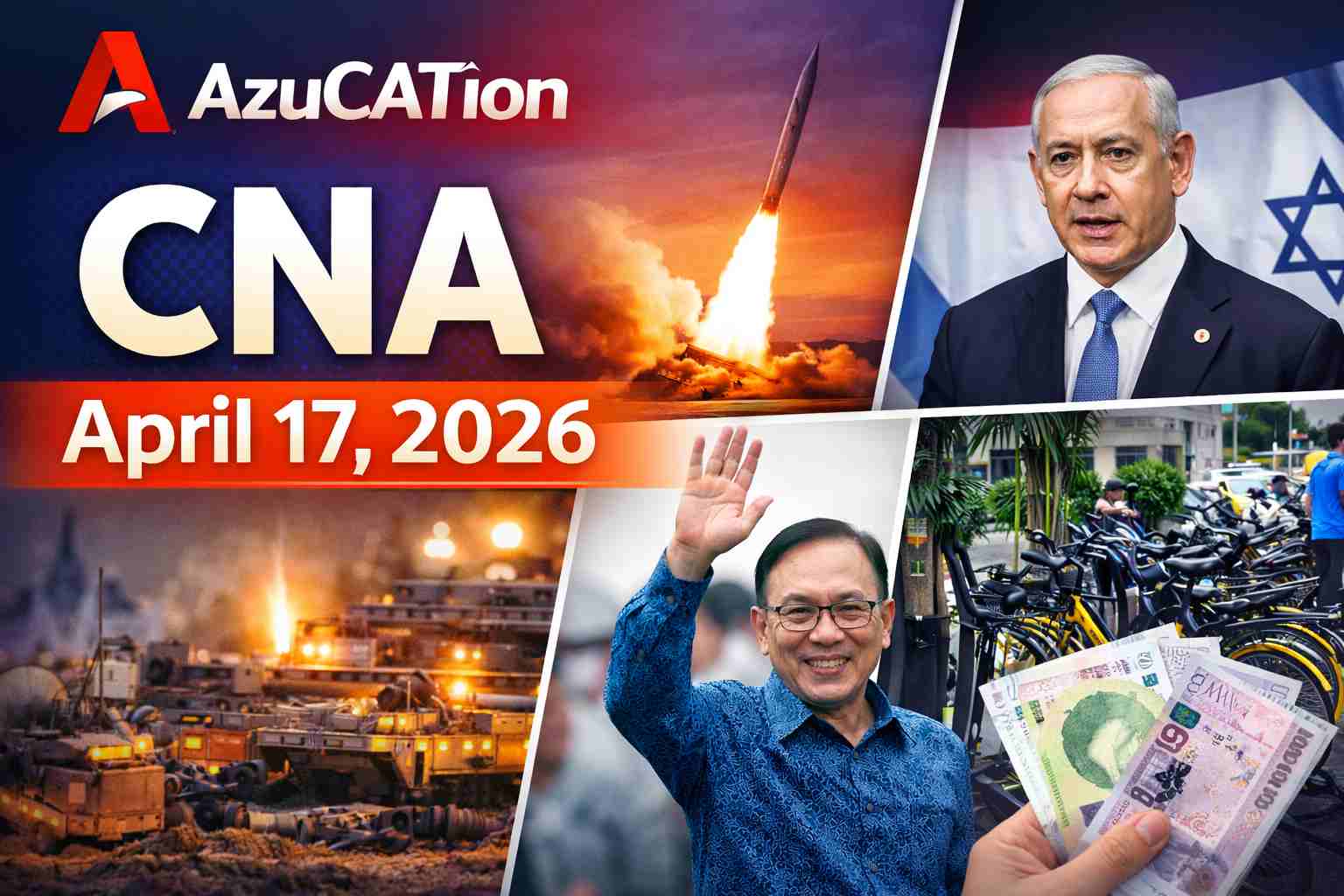
CNA April 17, 2026 | West Asia shock, AI risk, wage reset, Wipro signal & farm policy reboot
A daily one-stop current affairs page for MBA aspirants, GD-PI, WAT, placements, and other competitive exams — built from the day’s business, economy, technology, policy, and strategy news.
Today’s edition has one core message: management cannot be separated from geopolitics anymore. A war far away is affecting India’s trade, inflation, hiring, oil strategy, and business confidence. At the same time, AI is no longer just an efficiency story — it is becoming a governance and cybersecurity story. Add labour unrest, wage recalibration, and climate-linked farm policy, and you get the exact kind of multi-dimensional thinking that MBA interviews now expect.
Quick Navigation
- CNA Snapshot in 90 seconds
- 1. West Asia shock and India’s economic exposure
- 2. Wipro’s results: buyback, weak outlook, boardroom signal
- 3. AI agents, cybersecurity and regulatory lag
- 4. Wage floor, labour stress and the jobs question
- 5. Farm policy reboot, rural economy and El Niño risk
- 6. What to say in GD-PI today
- 7. One article to read
- 8. RC quiz with score and answer analysis
CNA Snapshot in 90 seconds
1. West Asia shock and India’s economic exposure
Why this is the biggest story of the day
The most important current-affairs lesson today is that trade routes, energy dependence and inflation are deeply interconnected. India’s March trade data shows visible stress from the West Asia war. Exports fell, imports fell, Gulf-facing trade took a major hit, and the pressure is not only commercial — it also feeds into oil prices, rupee management and policy response.
For MBA aspirants, this is not just a news point. It is a ready-made case study on supply-chain fragility, concentration risk, energy security, and macro transmission.
- India’s March goods exports fell 7.4% year-on-year, and imports fell 6.5%.
- Exports to the UAE fell 61.9%, and exports to Saudi Arabia fell 45.7%.
- Gulf countries account for roughly 14% of India’s exports and 19.5% of its imports.
- India depends on the Gulf for about 40% of its oil and gas imports.
- The IMF’s latest regional update says Asia is bearing the brunt of the new energy shock, with inflation pressure rising again.
This is exactly why energy diversification, supplier diversification and strategic reserves matter. Countries may look efficient in normal times, but crises reveal whether they are merely efficient or actually resilient.
- How should India reduce energy dependence without damaging growth?
- Should governments use broad subsidies in such shocks, or targeted support?
- What is the difference between efficiency-led supply chains and resilience-led supply chains?
Strong GDP growth or optimistic market narratives mean little if a country’s energy, shipping and import dependencies can be disrupted so quickly.
The larger insight is simple: macroeconomics is no longer just about domestic policy. It is now equally about how well a country can absorb external shocks. That is a theme worth using in essays, interviews and group discussions.
2. Wipro’s results: buyback, weak outlook, boardroom signal
What happened
Wipro announced a ₹15,000 crore buyback, while reporting a 1.9% year-on-year drop in Q4 profit and a cautious near-term outlook. Revenue rose in reported terms for the quarter, but the company’s broader narrative is still one of slow deal ramp-up, intense competition and uncertain discretionary spending.
- A buyback can signal confidence, but it can also show that management sees limited near-term avenues for superior reinvestment.
- Wipro’s case is a good reminder that deal wins are not the same as revenue realization.
- In IT services, clients may still invest in cloud, data and AI, but decision cycles can lengthen and margins can tighten.
This is a classic management-school conversation: When should a company return cash to shareholders, and when should it invest aggressively? The answer depends on growth visibility, capital discipline, strategic clarity and market expectations.
- Is a buyback always a positive sign?
- What is the difference between earnings quality and earnings optics?
- How do geopolitical shocks affect IT companies even when they are not directly in the war zone?
Use this story to show that you understand the difference between headline corporate action and underlying operating reality. That is exactly the kind of nuance good interview panels look for.
3. AI agents, cybersecurity and regulatory lag
The conversation around AI just became more serious
Today’s AI story is not about chatbots writing emails. It is about frontier AI being capable enough to identify and exploit software vulnerabilities. Anthropic’s Project Glasswing highlights how rapidly AI’s cybersecurity implications are escalating. Meanwhile, India’s fintech ecosystem has reportedly been advised to strengthen defenses, and experts are warning that India still lacks a dedicated framework for autonomous AI agents.
- AI is no longer just a productivity question. It is also a risk, audit, compliance and governance question.
- When AI agents interact with other systems autonomously, accountability becomes harder to assign.
- Boards that discuss AI only as a growth tool may be underestimating its threat surface.
This matters especially for finance, banking, fintech and healthcare — sectors where the cost of system failure is enormous. A mature manager should be able to say: innovation without control is not transformation; it is unmanaged risk.
- Should regulation lag innovation, match innovation, or move ahead of it?
- Who is liable when autonomous AI systems trigger harmful downstream decisions?
- Should Indian companies prioritize fast adoption or trustworthy adoption?
The real question is no longer “Will AI be used?” The real question is “Will it be used under governance strong enough to preserve trust?”
4. Wage floor, labour stress and the jobs question
Why this story matters more than it first appears
The Centre is exploring a sharp increase in the national daily minimum wage to roughly ₹350–450, up from the older floor level of ₹176. At the same time, youth unemployment has touched a recent high, and hiring sentiment remains vulnerable if global conflict persists. This is where labour economics, inflation, productivity and political economy meet.
- Worker welfare: rising prices make stagnant wages politically and socially unsustainable.
- Business costs: wage hikes affect cost structures, especially in labour-intensive sectors.
- Automation pressure: if firms feel wage pressure without productivity gains, they may accelerate automation.
This is why labour reform cannot be reduced to “higher wages versus business pain.” The real issue is whether India can create better-quality jobs, better enforcement, and higher productivity at the same time.
- Do minimum wage hikes always hurt employment?
- How should India balance labour protection with competitiveness?
- Is the jobs crisis about lack of jobs, poor quality jobs, or skill mismatch?
In an MBA interview, a good answer here must show balance: workers need dignity, firms need viability, and the economy needs productivity-led wage growth.
5. Farm policy reboot, rural demand and El Niño risk
Agriculture remains central to India’s economy
Agriculture and allied activities still contribute significantly to India’s economy while supporting a very large share of employment. That is why the move toward state-specific agricultural road maps is important. The idea is to shift from generic national planning to local solutions based on agro-climatic conditions, water availability, crop suitability and market linkages.
- Agriculture still matters for rural demand, inflation, employment and food security.
- Policy design is becoming more localized because climate stress is not uniform.
- El Niño risk means monsoon uncertainty can no longer be treated as a seasonal footnote.
This topic is useful because it lets you combine economics, climate, public policy and business. Companies selling FMCG products, tractors, fertilizers, credit, insurance and agri-tech services all depend on the health of the rural economy.
- Why do state-specific policies often outperform one-size-fits-all policies?
- How does climate change alter business strategy, not just environmental policy?
- Can agri productivity improve without better market linkages?
6. What to say in GD-PI today
A sharp 45-second summary you can use
“The biggest lesson from today’s news is that resilience has become as important as growth. India is facing the second-order effects of the West Asia war through trade, oil, inflation and hiring sentiment. At the same time, AI adoption is moving from experimentation to governance, especially as cyber risks become more serious. Domestically, labour stress and wage revision show that growth quality matters, while agriculture reminds us that climate resilience is now an economic issue. If I had to summarise the day in one line, I would say that strategy today means managing interconnected risks, not just chasing isolated opportunities.”
5 high-quality MBA interview questions from today’s themes
- How can India protect growth when major external shocks hit trade and oil routes?
- Does a corporate buyback reflect strength, weakness, or disciplined capital allocation?
- Should India regulate AI agents before scale adoption, or after real-world use cases mature?
- What is the right way to think about minimum wage in a developing economy?
- Why is climate resilience now a business and strategy issue, not only a policy issue?
7. One article to read today
The new management syllabus is geopolitics
For a long time, management education encouraged students to separate the world into neat boxes. Finance was one box. Marketing was another. Operations lived somewhere else. Public policy was treated as a distant subject and geopolitics was seen as something that belonged to diplomats, defence analysts or newspaper editorials. That separation is now breaking down.
The events of the last few years, and especially the current West Asia crisis, show why. A conflict that begins outside India does not remain outside India. It travels through shipping routes, oil prices, insurance costs, exchange rates, airfares, freight bills, hiring plans and consumer sentiment. An executive discussing margins in Mumbai may soon be discussing the Strait of Hormuz without ever intending to become a geopolitical analyst.
This is precisely why MBA aspirants need to update the way they read the news. The purpose of current affairs is not to collect facts mechanically. The purpose is to understand transmission. How does a war affect inflation? How does inflation affect consumer behaviour? How does weaker demand alter corporate guidance? How does uncertainty change hiring? How does all of this influence policy?
Today’s news offers a near-perfect illustration. India’s trade numbers suggest that the West Asia war is not just a foreign-policy story. It is a trade story, an energy story and an inflation story. If exports to major Gulf markets fall sharply and import routes remain under pressure, then firms face both demand-side and supply-side uncertainty. That, in turn, changes investment behaviour. Companies become more cautious, governments are forced to think about targeted support rather than broad generosity, and central banks become more alert to inflation spillovers.
The same principle applies to technology. Artificial intelligence is often presented as a simple productivity revolution. But when frontier models become capable of identifying vulnerabilities or acting autonomously across systems, AI stops being only a product story. It becomes a governance story. It becomes a compliance story. It becomes a boardroom story. The smartest managers will not be those who adopt technology fastest at any cost. They will be those who combine speed with control, experimentation with trust, and innovation with accountability.
Labour news tells a similar story from another direction. Wage floors, worker unrest and unemployment statistics are not merely social indicators. They shape business competitiveness, consumption power, automation decisions and political stability. A company can celebrate lower costs in the short term, but if wage growth remains weak, job quality poor and productivity stagnant, the larger economy loses depth. Demand becomes fragile. Trust declines. Social stress rises.
Agriculture adds the final piece. In India, rural outcomes still influence inflation, livelihoods, demand and political confidence. If climate-linked risks such as El Niño threaten output, then agriculture is not a “traditional” topic that modern managers can ignore. It becomes central to forecasting, procurement, rural sales, insurance, credit quality and public policy.
The deeper lesson is this: management today is the art of connecting dots early. A good future manager should be able to see that energy security influences inflation, inflation influences wage pressures, wage pressures influence profitability, profitability influences hiring, and hiring influences social confidence. A similarly good manager should understand that AI without governance can damage trust faster than AI can create value.
In that sense, the new management syllabus is not just accounting, marketing or operations. It is resilience. It is systems thinking. It is the ability to recognise that the world no longer rewards leaders who understand only one function in isolation. It increasingly rewards leaders who can interpret volatility without panic, complexity without confusion, and uncertainty without intellectual laziness.
For MBA aspirants, that is the real use of daily news analysis. It is not about sounding informed. It is about training the mind to think in connections.
8. RC Quiz | Attempt the article above
Read the article carefully, then answer the following questions. On submission, your score, analysis, correct answers and detailed explanation for each option will appear automatically.
Q1. Which of the following best captures the central argument of the passage?
Why B is correct: The entire passage argues that management now requires an integrated understanding of geopolitics, AI, labour, agriculture and strategy rather than siloed thinking.
Why A is wrong: The passage says exactly the opposite — business managers can no longer ignore geopolitics.
Why C is wrong: AI is only one example used by the author; it is not presented as the single biggest issue over all others.
Why D is wrong: The passage does not attack finance or marketing; it argues that these must now be connected with broader realities.
Q2. Which assumption is most strongly underlying the author’s argument about resilience?
Why C is correct: The passage repeatedly suggests that apparent efficiency is insufficient if a system cannot absorb shocks. That is the logic behind the resilience argument.
Why A is wrong: The author does not claim efficiency is always superior; rather, the passage warns against overvaluing efficiency without resilience.
Why B is wrong: This directly contradicts the passage, which shows how global shocks transmit into domestic inflation, hiring and trade.
Why D is wrong: The author does not advocate total state control; the discussion is about better strategy and policy design, not replacing markets.
Q3. Which of the following, if true, would most weaken the passage’s warning that AI has become a boardroom governance issue?
Why C is correct: If software exploitation and autonomous system risk are almost irrelevant in practice, the author’s warning about AI governance becomes much weaker.
Why A is wrong: More AI pilots actually support the idea that governance matters.
Why B is wrong: This strengthens the warning, not weakens it.
Why D is wrong: This also strengthens the author’s position by showing that industry actors themselves see the risk as serious.
Q4. The tone of the passage is best described as:
Why B is correct: The author is clearly analysing interconnected risks while warning readers against simplistic or siloed thinking.
Why A is wrong: The piece is not selling or celebrating anything; it is reflective and strategic.
Why C is wrong: There is no ridicule or dismissal in the author’s voice.
Why D is wrong: The passage is future-focused and systems-oriented, not nostalgic.
Your RC Result
Want Daily CNA + Mock Tests + GD/PI Prep?
Join AzuCATion's 2026-28 MBA preparation program — from Ranchi to IIMs.
💬 WhatsApp AzuCATionEdition source note
This edition synthesizes:
- Business Standard Delhi, 17 April 2026
- Mint Delhi, 17 April 2026
- Economic Times Delhi, 17 April 2026
- Wipro official Q4 FY26 results release
- Anthropic – Project Glasswing
- IMF – Asia’s economic resilience and the energy shock
- IMF – World Economic Outlook, April 2026
- Ministry of Commerce – FTA updates
The “article to read” section above is an original study passage created for exam preparation and RC practice, not a direct reproduction of any single newspaper article.