


 AzuCATion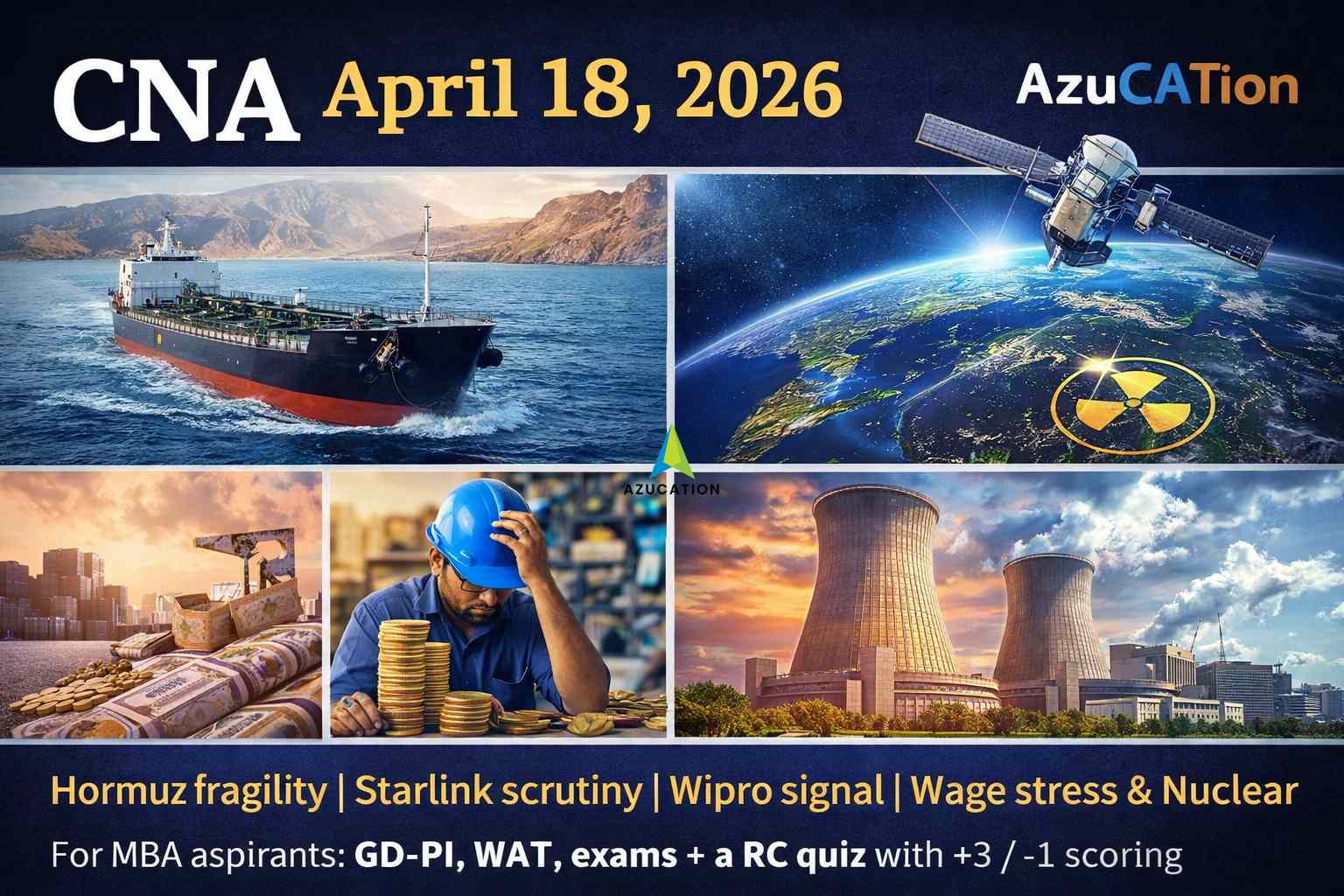
CNA April 18, 2026 | Hormuz fragility, Starlink scrutiny, Wipro signal, wage stress & nuclear opening
A one-stop current affairs page for MBA aspirants, GD-PI, WAT, placements, and other competitive exams — built from the day’s business, economy, technology, policy, and strategy news.
Today’s edition revolves around a simple management truth: systems look stable until stress tests reveal where power really lies. One chokepoint in West Asia affects oil, currency management, shipping, and India’s payment choices. One satellite internet company becomes a national security debate, not just a telecom story. One corporate buyback forces a deeper question about growth quality. And one wage debate shows how policy intent and lived reality often diverge.
Quick Navigation
- CNA Snapshot in 90 seconds
- 1. Hormuz, oil, rupee and India’s macro shield
- 2. Starlink and the national security test
- 3. Wipro: buyback, bookings and the growth question
- 4. Wage hikes, EPFO rethink and the real jobs story
- 5. Nuclear FDI and India’s long-power game
- 6. How to use these topics in GD-PI and WAT
- 7. One article to read today
- 8. RC quiz with score and explanation
- 9. Source stack
CNA Snapshot in 90 seconds
1. Hormuz, oil, rupee and India’s macro shield
Why this is the most important business story of the day
Iran has signalled that the Strait of Hormuz is open to commercial shipping, but the reopening remains conditional and the security situation is still not fully normal. Shipping groups are seeking clarity on mines, routing, and enforcement, which means the headline may sound calming while operational risk remains high.
For India, this matters immediately. Oil is not just an energy input; it is also a currency story, an inflation story, and a working-capital story. That is why even a modest de-escalation changes sentiment in equities, crude, and the rupee.
- Geopolitical shocks move through three channels: price, payments, and transport.
- India’s response is not only diplomatic; it is also financial and operational.
- When uncertainty rises, central banks and governments often create side-windows, special arrangements, and temporary workarounds to protect stability.
A second layer of this story is even more interesting. Under a temporary US waiver, Indian refiners have reportedly been settling some Iranian oil payments in Chinese yuan through ICICI Bank’s Shanghai branch. That is more than a trade detail. It is a live example of how sanctions and conflict can accelerate non-dollar settlement and payment innovation.
- Does repeated geopolitical stress accelerate de-dollarisation?
- Should India prioritise cheapest energy or most secure energy?
- What is the difference between efficiency and resilience in supply chains?
Use this topic to show panels that you understand transmission. Do not stop at “oil prices may rise.” Go one level deeper: higher crude can affect inflation expectations, import bills, rupee demand, shipping insurance, and even consumer prices in unrelated sectors.
2. Starlink and the national security test
Why this matters beyond one company
The reported hold-up in Starlink’s India progress is a classic case of how emerging technology collides with state capacity and national security. The issue is not whether satellite internet is useful. It clearly is. The issue is whether a government feels it can retain enough control over a cross-border communications layer during conflict or misuse.
That is why this is a management and public-policy story at the same time. Many students treat regulation as an obstacle. In reality, regulation often acts as a signal that the state has reclassified a business from “commercial service” to “strategic infrastructure”.
- Not all infrastructure is physical anymore; connectivity itself is infrastructure.
- In sectors like telecom, payments, and AI, speed of innovation does not automatically outweigh state concerns about misuse.
- For firms, market entry strategy in such sectors must include compliance architecture, not just distribution and pricing.
- Can India be pro-innovation and security-first at the same time?
- Should critical digital infrastructure be treated like ports, power, and defence assets?
- How do global companies build trust in heavily regulated strategic sectors?
This is one of the best examples you can use to explain why all growth markets are not frictionless markets. In strategic sectors, legitimacy matters almost as much as technology.
3. Wipro: buyback, bookings and the growth question
What happened
Wipro’s board approved a ₹15,000 crore buyback at ₹250 per share. For Q4 FY26, net income fell 1.9% year-on-year, while the company guided Q1 FY27 IT services revenue to a range that implies -2.0% to 0% sequential constant-currency growth. At the same time, Wipro reported stronger large-deal bookings and continued to speak about its AI-first pivot.
- A buyback can be good capital discipline, but it does not erase questions around growth quality.
- Strong bookings are encouraging, yet investors still ask when bookings will convert into durable revenue acceleration.
- The AI narrative is real, but the market now wants proof that AI-led positioning can translate into margin-safe growth.
This is why Wipro is such a useful case study for management students. It sits at the intersection of shareholder return, strategic repositioning, execution risk, and near-term market patience.
- Is a buyback a sign of strength, caution, or both?
- How should an IT services firm respond when AI changes client expectations faster than budgets?
- Why do markets often reward credible visibility more than isolated headline actions?
4. Wage hikes, EPFO rethink and the real jobs story
Why this section matters for interviews
One of the most useful traps in interviews is when candidates celebrate a policy headline without examining delivery. Today’s wage story is exactly that. Workers in industrial belts report that rising minimum wages do not automatically create real financial relief when living costs, uncertain implementation, overtime abuse, and contractual hiring continue to eat into stability.
At the same time, the government is reportedly revisiting a rise in the EPFO wage ceiling from ₹15,000 to ₹25,000-30,000. In principle, that can widen formal social security coverage. In practice, it also raises questions about employer cost, compliance, take-home pay, and how many workers actually remain outside regularised systems.
- Jobs must be assessed on quantity, quality, stability, and protection.
- A wage hike without enforcement, benefits, and formalisation can become only a partial win.
- Good labour policy is not only about pay; it is about safety nets, portability, and bargaining power.
- Should India focus first on job creation or job formalisation?
- Can higher social security coverage reduce short-term take-home pay but improve long-term household stability?
- What is the difference between minimum wage, fair wage, and living wage?
This story is especially valuable for MBA aspirants because it pushes you to speak beyond ideology. Neither “wages must rise” nor “firms need flexibility” is enough. The mature answer is about balancing competitiveness with dignity and long-run productivity.
5. Nuclear FDI and India’s long-power game
Why this is bigger than a policy tweak
The reported clearance of a new foreign investment policy for the nuclear power sector signals that India is trying to align three goals at once: energy security, clean baseload power, and long-duration industrial growth. That is a serious strategic question, not just a sectoral update.
The broader backdrop is the SHANTI Act, 2025, which has already passed Parliament and marks a major rethink of India’s nuclear framework. But passing a law is the easy part. Real progress depends on financing, project timelines, risk allocation, technology partnerships, and public acceptance.
- Energy transition is not only a climate debate; it is a capital allocation and execution debate.
- Nuclear expansion requires patience, credibility, and institutional continuity.
- In strategic sectors, private participation works only when policy clarity and risk-sharing are believable.
- Should strategic sectors invite foreign capital if the state retains control over safety and oversight?
- Can nuclear complement solar and wind in India’s energy mix?
- What matters more in infrastructure: low cost today or reliability over decades?
6. How to use these topics in GD-PI and WAT
7. One article to read today
“Wild food is always shared food” — today’s Mint Lounge feature offers a quietly powerful lesson in patience, reciprocity, urban ecology, and how humans relate to nature.
For MBA and exam aspirants, this is useful because strong RC performance is not built only on business pages. Good readers are flexible readers. This piece trains you to handle reflective prose, subtle tone, metaphor, and argument that unfolds gently rather than aggressively.
What to notice while reading: the shift from observation to philosophy, the author’s changing idea of ownership, and the move from consumption to coexistence.
Note: the practice passage below is original and written in the same broad thematic zone for exam use. It is not a reproduction of the published article.
8. RC quiz with score and answer analysis
Original RC Passage: Waiting, sharing and the meaning of enough
In cities, food is usually treated as a product of certainty. We expect it to be available in the same shape, size and taste whenever we want it. Supermarkets and delivery apps teach us that convenience is normal and delay is failure. But wild food belongs to a different logic. It resists standardisation. It arrives when the season allows, not when the buyer demands. Some fruits ripen earlier than others. Some leaves are already torn by insects. Some flowers fall before humans can collect them. To take food from such a world is to accept that one is entering a system that was functioning before one arrived and will continue after one leaves.
This changes the emotional meaning of consumption. When a person plucks from a tree in a forest, a roadside patch, or a balcony that has become unexpectedly alive, the act is no longer only about appetite. It becomes an act of attention. One has to notice whether the plant is recovering, whether birds have begun feeding there, whether insects are using it as shelter, and whether taking too much would alter the balance of the place. Wild food therefore introduces a moral pause into consumption. It asks not merely, “Can I take this?” but also, “How much is fair to take?”
Such a question feels strange in modern urban life because most systems train people to maximise. If something is useful, they are encouraged to extract as much value as possible. But ecological relationships work on a different arithmetic. They reward restraint more than conquest. A person who leaves part of a harvest behind is not losing; rather, that person is helping preserve the conditions that will make future harvests possible. In that sense, waiting is not passivity. It is participation in renewal.
The discipline of waiting also alters perception. A person who must return to a tree after weeks of heat, wind or rain begins to see time differently. Growth stops looking automatic and starts looking earned. What seemed ordinary becomes worthy of regard. A leaf is no longer just an ingredient but the visible result of sunlight, water, vulnerability and survival. By slowing the consumer, the natural world turns attention into gratitude. The consumer stops behaving like an owner and begins behaving like a guest.
That may be the most important lesson wild food offers to urban society. The point is not that everyone should begin foraging. The deeper value lies in recovering a relationship with limits. In a culture obsessed with speed, abundance and control, wild food reminds people that enough is often wiser than more. It teaches that sharing is not charity added after consumption; it is a principle that should shape consumption from the beginning.
Your RC Result
Check your score and analysis below.
Want Daily CNA + Mock Tests + GD-PI Prep?
Join AzuCATion’s 2026-28 MBA preparation program — from basics to interviews.
WhatsApp AzuCATion9. Source stack
This edition synthesizes:
- Business Standard Delhi edition, 18 April 2026
- Economic Times Delhi edition, 18 April 2026
- Mint / Mint Lounge Delhi edition, 18 April 2026
- Wipro official Q4 FY26 results release
- Reuters updates on Hormuz and Iran oil payments
- Business Standard report on nuclear FDI policy
- PRS India bill-track note on the SHANTI Act, 2025
Tip for daily publishing: keep the structure unchanged, update hero title, quick-nav links, the five main sections, the article-of-the-day block, and the RC passage/quiz.
AzuCATion CNA is designed to help students move from passive news consumption to analytical thinking for CAT, XAT, SNAP, NMAT, GD-PI, WAT, placements, and interview conversations.