


 AzuCATion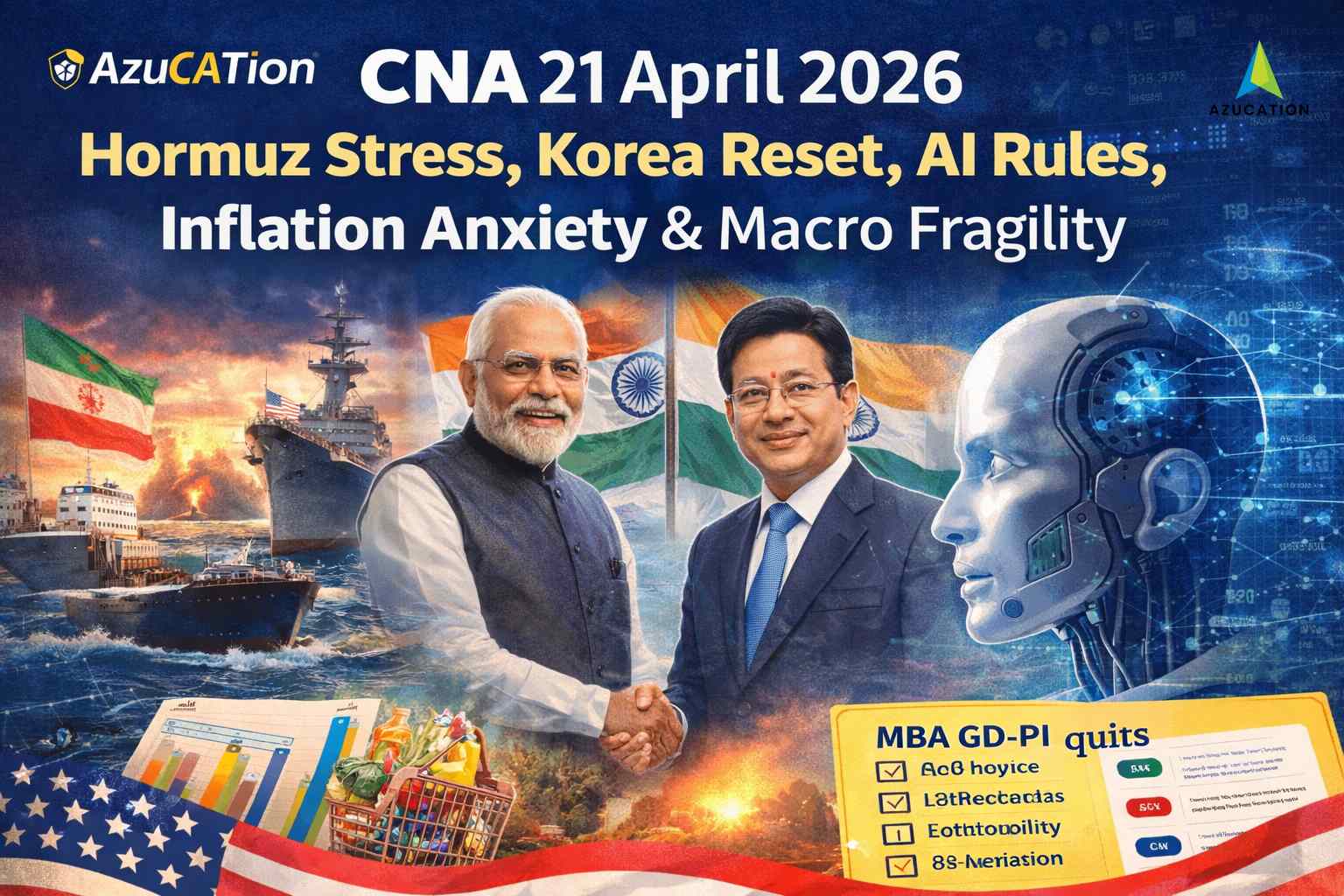
CNA 21 April 2026 | Hormuz Stress, Korea Reset, AI Rules, Inflation Anxiety & Macro Fragility
Today’s news is not one story. It is one chain. West Asia uncertainty is pushing oil higher, pulling markets lower, delaying trade talks, widening India’s macro worries, and sharpening the Reserve Bank’s caution. At the same time, India is trying to build fresh external partnerships with South Korea, prepare a formal policy architecture for AI, and manage domestic pressure points from reservoirs to transport to food buffers. For MBA aspirants, this is a perfect day to study how geopolitics, policy, business, markets, and technology are deeply connected.
Today’s editorial frame
The big lesson of 21 April 2026 is strategic resilience. India cannot think of oil, inflation, trade, AI, logistics, and industrial policy as separate chapters anymore. The real competitive advantage now lies in how quickly a country can absorb shocks, redesign rules, protect growth, and still move forward with long-term capability building.
Why this CNA matters for GD-PI
This page helps you answer interview questions on oil shocks, second-round inflation, CEPA and trade diplomacy, AI regulation, last-mile public transport, business model innovation, rural vulnerability, and market reaction to geopolitical conflict. Read it not as news consumption, but as answer-building material.
What changed on 21 April 2026?
The front page signals were clear. West Asia remains unstable, the Strait of Hormuz is still central to the risk map, India’s macro vulnerability is getting discussed more openly, and policymakers are no longer pretending that technology can be left to market evolution alone. The day is equally about crisis and redesign.
Three themes dominate. First, the external shock: oil, shipping, capital flows, current account worries, and growth risks are all being reshaped by the conflict around Iran, the US, and the Gulf route system. Second, the strategic reset: India is trying to hedge that uncertainty through new partnerships, especially with South Korea, while also pushing bilateral trade talks with the US and revisiting market access logic. Third, the domestic preparedness story: India is reviewing rural schemes, watching inflation perceptions, building food buffers, thinking about AI governance, and exploring better public transport frameworks.
Geopolitics became economics
Hormuz is no longer a distant map issue. It is now directly linked to oil, trade, logistics, inflation expectations, and market sentiment.
Trade diplomacy became strategic
India-Korea CEPA upgrade, shipbuilding cooperation, and US market access talks all show that trade is now about resilience as much as tariffs.
AI moved from excitement to rules
India’s new AI governance push suggests the next phase will be regulation, sandboxes, accountability, reskilling, and sector-specific outcomes.
Domestic weak spots stayed visible
Reservoir dependence, felt inflation, informal transport, rural scheme reviews, and food buffers remind us that macro stress always lands locally.
Hormuz stress: from shipping lane to inflation lane
The single biggest analytical mistake students make in GD-PI is treating West Asia as “foreign affairs” and inflation as “economics”. Today’s papers show why that separation fails. When shipping through Hormuz gets threatened, energy prices rise. When energy prices rise, import bills increase. When import bills increase, inflation risk returns, the current account worsens, fiscal pressure rises, investor confidence weakens, and central banks become more cautious. That is not theory. That is the operating logic of this week.
The geopolitical picture remained tense. Peace efforts were unstable, the US seized an Iranian cargo vessel, Tehran pulled back from talks, and uncertainty around the ceasefire framework continued. This matters because a prolonged closure or repeated disruption around Hormuz hurts not just oil supply but also insurance costs, shipping schedules, and business planning. India has been in touch with regional players and remains focused on safe passage for ships, especially critical energy cargo.
The business and macro consequences are already visible. Foreign portfolio investors have seen 2026 turn into a record year of net equity selling, with roughly ₹1.68 trillion in outflows so far and March alone contributing around ₹1.1 trillion. Brent crude has hovered around the $90 mark. India’s core sector output contracted 0.4% in March, the first drop in five months, with crude oil, coal, fertilizer, and electricity all declining. That is why this is not a narrow oil story; it is a growth-quality story.
Why the Reserve Bank is sounding careful
RBI Governor Sanjay Malhotra’s larger message is important for interviews: first-round shocks are painful, but second-round effects are more dangerous. In simple terms, a one-time oil spike is bad, but a persistent shock that gets embedded into wages, transport costs, food prices, and inflation expectations is far worse. That is when monetary policy cannot stay relaxed.
This is where today’s inflation discussion becomes crucial. Official retail inflation may still look manageable, but household inflation expectations have moved up sharply. If citizens feel inflation is rising and begin changing spending, stocking, saving, and demand behaviour, then “felt inflation” starts becoming an economic force in itself. The central bank cannot ignore that psychology even when official numbers remain lower.
NITI Aayog’s report-based concerns over a widening current account deficit fit the same picture. India’s dependence on imported energy means global conflict gets domestically transmitted. Even sectors not directly linked to oil, such as jewelry exports, logistics, or state finances, start facing second-round cost pressures. Railways is even considering relief for container train operators hit by the trade slowdown and idle capacity burden. That is how a distant conflict starts appearing in freight economics inside India.
Three deeper implications for MBA aspirants
- Macro answers need transmission logic. Do not say “oil prices are rising”. Explain who pays, how costs move, why policy reacts, and which sectors take the first hit.
- Operations and supply chain interviews can use this case. Container stabling costs, underutilised freight capacity, and insurance redesign all show how shocks affect asset productivity.
- Finance interviews should connect markets and policy. Outflows, rupee management, NDF rules, treasury pressure, and valuation de-rating are part of the same story.
India-Korea reset: trade diplomacy is becoming strategic diplomacy
On the same day that global uncertainty deepened, India and South Korea tried to widen the horizon. The two countries signaled an ambition to nearly double bilateral trade from around $27 billion to $50 billion by 2030 and to upgrade the CEPA within one year. This is not just a ceremonial diplomatic line. It is a strategic move in a world where supply chains, semiconductors, shipbuilding, steel, technology, and trusted partners matter far more than before.
But the relationship also carries an important economic realism. India’s trade deficit with South Korea remains large. Imports from Korea in 2024-25 were around $21.06 billion, while exports stood near $5.82 billion, producing a deficit of about $15.24 billion. So, the phrase to remember here is not “more trade” alone. It is “more balanced trade”.
That balance matters because the next generation of trade agreements cannot survive politically if one side sees itself as structurally disadvantaged. This is why the vocabulary around non-tariff barriers, rules of origin, market access, and easier bilateral business has become central. India is no longer willing to treat FTAs as automatic achievements. It wants strategic usefulness and domestic credibility.
Why this meeting matters beyond numbers
The South Korea track is important for at least four reasons. First, it gives India a trusted industrial partner in shipbuilding, electronics, semiconductors, steel, and advanced manufacturing. Second, it fits India’s desire to diversify strategic economic relationships at a time of uncertain global blocs. Third, it aligns with India’s manufacturing and supply-chain ambitions rather than only merchandise trade arithmetic. Fourth, it shows that geopolitical shocks often accelerate selective partnerships rather than stop them.
The US angle also matters in parallel. India’s team is in Washington to work on the first phase of a bilateral trade arrangement, with a clear emphasis on preferential market access. Put together, the Korea conversation and the US conversation reveal a larger pattern: India wants a market access strategy that is more selective, more reciprocal, and more geopolitical than before.
Use this in WAT
“The future of trade agreements will be judged less by headline tariff cuts and more by supply-chain trust, technological cooperation, and domestic political sustainability.”
Keywords to remember
Balanced partnership, CEPA upgrade, rules of origin, non-tariff barriers, strategic industries, supply-chain diversification.
The MBA interpretation
The smart MBA answer here is not to glorify FTAs blindly. It is to show nuance. A good answer would say that India needs external integration for scale, competitiveness, and technology access. But India also needs trade design that does not leave domestic manufacturing politically exposed or structurally dependent. That is why “open but negotiated” is a stronger line than either protectionism or unconditional liberalisation.
AI in India is entering its serious phase: rules, use cases, power, and talent
The most forward-looking development of the day is India’s movement toward a unified legal and policy framework for AI companies. The newly constituted Artificial Intelligence Governance and Economic Group is expected to push for clearer boundaries, accountability norms, and regulatory sandboxes for companies building or offering AI tools in India. The direction is notable: India is trying to avoid two extremes at once — uncontrolled drift and premature overregulation.
The likely design philosophy is visible already. The state wants AI to remain innovation-friendly, but not law-light. It also wants money to be channelled into limited, measurable use cases over the next 12 to 18 months instead of distributing attention across everything fashionable at once. The sectors likely to get priority are health care, agriculture, and education. That is a strong signal that AI policy in India may become problem-led, not hype-led.
The real policy triangle
India’s AI debate is no longer just about chatbots. It is about governance, compute and power infrastructure, and human capital. Regulation without capability will slow adoption. Capability without guardrails will create trust deficits. Adoption without reskilling will increase labour anxiety.
That is why the reskilling and upskilling point is not decorative. It is central. Today’s broader technology coverage also reinforces that AI’s next phase will be constrained by talent gaps, infrastructure, and the economics of deployment. “Vibe coding” may sound exciting, but real businesses still need reliability, security, workflow clarity, and trained teams. Equally, the rise of AI data infrastructure is reopening old questions about energy, grids, chips, and even nuclear power.
How to talk about AI regulation in interview
Avoid saying “AI should be regulated” as a generic moral statement. That sounds superficial. A better answer is: India should regulate AI based on risk layers. Foundational models and sensitive use cases need higher transparency and accountability. Low-risk business tools need sandbox-led flexibility. Public sector use needs auditability. Consumer-facing systems need clear grievance and disclosure rules. Labour-side disruption needs reskilling architecture.
That answer shows balance, sequencing, and policy design thinking. It sounds managerial rather than slogan-driven.
Use this phrase
“India should not chase AI prestige without building AI institutions.”
What interviewers want to hear
Clarity on sectoral use cases, regulatory proportionality, talent transition, data responsibility, and energy-compute realism.
Domestic stress map: reservoirs, felt inflation, food buffers, transport gaps
One of the strongest features of today’s coverage is that it takes national stress down to the household and city level. That is what good current affairs analysis should do. Big news becomes useful only when we understand how it travels into daily life.
Reservoirs: good for now, vulnerable later
India’s 166 key reservoirs are currently at 44.7% of live capacity, higher than last year and above the normal benchmark. On the surface, that sounds reassuring. But the warning is in the forward view, not the current stock. If monsoon rainfall remains sub-normal, replenishment will weaken, irrigation stress can grow, and food output can face pressure later. The southern region already looks relatively weaker than last year, while the eastern region is close to its normal benchmark rather than comfortably above it.
Inflation anxiety: the psychology is running ahead of the print
The most fascinating macro story is not official inflation. It is perceived inflation. Households continue to feel inflation 4% to 6% above the official CPI. March CPI may have been only 3.4%, but current felt inflation perception is much higher, and future expectations have risen. Three-month-ahead median expectation is around 8.5%, and one-year-ahead expectation about 8.8%. Among more vulnerable groups such as daily workers and retired persons, inflation anxiety has moved even faster.
This matters because business decisions, salary pressure, consumption choices, and political moods are often shaped by lived inflation, not reported inflation. An MBA candidate who understands this difference immediately sounds stronger in interviews.
Food buffers: chana is not a small story
The government’s plan to build a larger chana buffer shows how seriously policymakers are taking the food side of the risk equation. Chana may sound like a narrow agriculture story, but it sits at the intersection of monsoon risk, food inflation, retail affordability, and FMCG input cost visibility. In stressed times, small food-management decisions often become macro-stability instruments.
Urban transport: India’s forgotten productivity story
One of the most under-discussed but high-quality policy stories of the day is NITI Aayog’s work on a national framework for informal first- and last-mile transport. An estimated 200 to 300 million Indians depend heavily on private rickshaws, tempos, and minibuses for last-mile movement, yet only 66 of India’s 496 cities with populations above 100,000 have government-run systems. That is not just a mobility gap. It is a productivity gap, a governance gap, and a quality-of-life gap.
Students should note how important this is for future MBA discussions. Transport is not merely an infrastructure topic. It affects labour mobility, women’s safety, household costs, informal-sector regulation, and the competitiveness of urban economies.
Business and market signals: what managers should notice today
1) RBI gives selective relief, not a clean reversal
The central bank eased parts of its forex restrictions for banks by allowing genuine back-to-back hedging transactions, including related-party hedges in certain cases, while retaining the broader discipline of the $100 million cap on net open positions. This is a subtle but important management lesson: in crisis conditions, regulators often calibrate rather than capitulate. Good policy design does not move from tight to loose in one jump; it distinguishes between speculative activity and legitimate risk management.
2) ICICI Bank’s quarter says quality still matters
ICICI Bank’s strong Q4, helped by better loan growth and sharply lower provisions, reinforces a classic finance principle: in uncertain times, investors reward balance-sheet credibility faster than headline excitement. Even when expenses or margin pressures remain, strong asset quality and controlled credit costs can reopen the case for re-rating.
3) Maruti shows how demand can exist alongside supply stress
Maruti Suzuki’s move to ramp production to clear more than 200,000 pending orders is a strong demand signal. Yet it is also an operations story about capacity planning, product mix flexibility, inventory compression, and market timing. Dealers reportedly sit at low inventory levels, while phased expansion through Kharkhoda and Gujarat could take capacity growth toward 500,000 units by the end of FY27. This is exactly the kind of case operations and strategy interviewers love.
4) Pocket FM is a reminder that monetisation models still matter
Pocket FM’s growth is not only a content story. It is a business-model story. The company is scaling via microtransactions along with premium plans, while also embedding AI into creation, editing, and product workflows. That is a useful managerial reminder that digital winners do not always copy the same subscription playbook; sometimes they build behaviour-specific monetisation instead.
5) Leadership and governance are back on centre stage
Private bank succession conversations, corporate conduct debates, antitrust friction, resolution delays in insolvency, and hospital pricing concerns all suggest that 2026 is increasingly becoming a governance year. Not every important business story is about revenue growth. Many of the most durable re-ratings come from cleaner institutions, stronger oversight, and predictable decision systems.
GD-PI-WAT preparation from today’s CNA
Five strong WAT/GD topics from 21 April 2026
1. Should India redesign growth strategy around resilience rather than efficiency?
Use: Hormuz stress, FPI outflows, core sector weakness, rural scheme reviews, container logistics, energy dependence.
Sharp angle: Efficiency is powerful in stable times; resilience becomes decisive in shock-prone times.
2. Does AI need ex ante regulation, or will that slow innovation?
Use: AI legal framework, regulatory sandboxes, sectoral prioritisation, reskilling, trust, security concerns.
Sharp angle: Good regulation should separate high-risk uses from broad experimentation.
3. Are FTAs now strategic instruments more than trade instruments?
Use: India-Korea CEPA upgrade, US market access talks, GCC delay, rules of origin, supply chain trust.
Sharp angle: In 2026, trade architecture is also industrial policy and geopolitical signaling.
4. Why is “felt inflation” politically and economically more powerful than reported inflation?
Use: Household perception gap, food-fuel importance, vulnerable groups, behavioural reactions, policy communication.
Sharp angle: Economies are managed through both statistics and expectations.
5. Can India formalise its informal urban transport ecosystem without damaging affordability?
Use: 200–300 million reliance, only 66 of 496 cities with systems, last-mile economics, regulation, safety, productivity.
Sharp angle: India’s transport challenge is not only infrastructure creation but systems integration.
6. Is India’s macro stability still too dependent on monsoon and imported energy?
Use: Reservoir data, chana buffer, oil shock, inflation expectations, CAD concerns, rural protection.
Sharp angle: Two old vulnerabilities still shape modern India: rainfall and fuel.
Interview questions with answer cues
Q1. Why is the Strait of Hormuz so important for India?
It is not only an oil route. It affects crude prices, shipping and insurance costs, current account pressure, inflation expectations, logistics planning, and investor sentiment. For India, it is a macro transmission channel.
Q2. What do you mean by second-round effects of inflation?
A first-round shock is the immediate price increase from oil or supply disruption. A second-round effect happens when that shock gets embedded into wages, transport, food prices, business pricing, and inflation expectations, making it persistent.
Q3. Why is the India-Korea story significant beyond bilateral trade?
Because it links trade with technology, shipbuilding, semiconductors, industrial partnerships, and supply-chain trust. It reflects a strategic partnership model rather than a narrow trade model.
Q4. Do you support AI regulation in India?
Yes, but proportionately. High-risk and public-impact AI systems need disclosure, auditability, and accountability. Lower-risk experimentation should move through sandboxes and innovation-friendly rules. Reskilling must be part of the framework.
Q5. Why should an MBA candidate care about reservoir levels?
Reservoirs affect irrigation, farm output, food prices, rural demand, inflation risk, electricity generation, and policy response. Water is a macro and business variable, not only a climate variable.
Q6. What is the difference between official inflation and felt inflation?
Official inflation comes from measured baskets. Felt inflation is the household experience of price rise, shaped especially by food and fuel. It influences behaviour, trust, and spending more directly.
Q7. What managerial lesson do you take from Maruti’s backlog story?
Demand visibility is useful only if backed by production flexibility, supplier coordination, model prioritisation, and dealer inventory discipline. Strategy without operations cannot convert demand into revenue.
Q8. Why is informal last-mile mobility a serious policy topic?
Because it affects labour mobility, urban productivity, affordability, regulation, safety, and emissions. When millions rely on unstructured transport, the problem is no longer informal; it is systemic.
Answer architecture you can use tomorrow
For almost every big topic from today, use this 4-step structure in GD-PI: context → transmission → trade-off → way forward. Example: “The conflict creates an oil shock. That transmits into inflation, CAD, and logistics. The trade-off is between stability and growth support. The way forward is diversified supply, calibrated policy, and institutional resilience.”
Must-remember numbers from today
| Data point | Value | Why it matters |
|---|---|---|
| India-flagged vessels transiting Hormuz since conflict began | 10 | Shows India’s real-time exposure to maritime risk and why diplomatic engagement is urgent. |
| Cities above 100,000 population with government-run transport systems | 66 of 496 | Reveals how dependent India remains on informal urban mobility networks. |
| Fertilizer sector growth in March | -24.6% | Sharp reminder that war-led input shortages can hit agriculture-linked industries fast. |
| March natural gas output | +6.4% | One of the few positive spots in a weak core-sector month. |
| Maruti pending bookings | 200,000+ | Strong demand signal, but also a capacity and delivery management challenge. |
| Pocket FM annualized revenue run-rate | $400 mn+ | Shows how microtransactions plus AI-enabled scale can create a differentiated digital media model. |
| AI use-case target horizon | 12–18 months | Signals a shift from broad ambition to measurable deployment in selected sectors. |
| RBI domestic market NOP discipline | $100 mn cap retained | Indicates selective easing without abandoning macro and currency discipline. |
RC mini-test for 21 April 2026
Passage theme: strategic resilience, not isolated news reading. Score with CAT-style marking: +3 for correct, -1 for wrong, 0 for unattempted.
Attempt Section as a Test
For years, countries optimised economic systems for efficiency. Supply chains were stretched across borders, inventories were kept lean, transport costs were minimised, and trade agreements were celebrated mainly for lowering barriers. That world has not disappeared, but it has been unsettled. Repeated shocks — pandemic disruption, wars, shipping bottlenecks, energy spikes, technology restrictions, and financial volatility — have exposed the cost of excessive dependence on narrow channels of supply and narrow assumptions of stability.
In such a world, resilience becomes a strategic asset. But resilience should not be confused with indiscriminate self-reliance or blanket protectionism. A resilient system is not one that shuts itself off. It is one that remains open while reducing fragile dependencies, building fallback capacity, diversifying partnerships, and improving institutional responsiveness. In fact, resilience often requires deeper engagement with external partners, not less. The difference is that the quality of integration changes. Countries begin asking harder questions about trust, redundancy, origin rules, logistics visibility, and regulatory coordination.
The same logic applies within economies. A city may look functional until a transport strike, flood, or fuel shock reveals how dependent it is on informal, thinly regulated systems. Inflation may appear contained in official statistics even as households feel persistent pressure from food and fuel. Banks may seem profitable until a period of volatility reveals the importance of hedging discipline, governance, and succession planning. In each case, the surface indicator is less useful than the system’s ability to absorb stress without disorder.
This implies a shift in managerial and policy thinking. Efficiency remains valuable, but it can no longer be the only criterion. The stronger question is whether a system can continue functioning when assumptions fail. That is why the best responses to modern shocks are rarely purely monetary, purely diplomatic, or purely technological. They are institutional. They involve better rules, better buffers, better information, and better coordination across layers that were once analysed separately. The challenge of our time is not merely to grow faster. It is to grow in a way that can survive reality.
Your Quiz Result
You scored 0 out of a maximum possible 12.
From AzuCATion
Students often ask: how do I improve my current affairs answers for MBA interviews? The answer is not by collecting more headlines. It is by learning how one headline talks to another. Today’s best preparation is to connect Hormuz to oil, oil to inflation, inflation to RBI, RBI to markets, markets to trade diplomacy, trade diplomacy to industrial strategy, and industrial strategy to AI, logistics, and resilience.
The student who understands connections will always outperform the student who memorises isolated facts. And remember this line for your interviews: in unstable times, capability is not enough; resilience becomes capability.
Want daily CNA + GD/PI + WAT + interview prep?
Join AzuCATion for structured MBA preparation with daily current affairs analysis, answer-building, interview frameworks, profile guidance, and serious discussion on business, economy, policy, and strategy.
WhatsApp AzuCATion