


 AzuCATion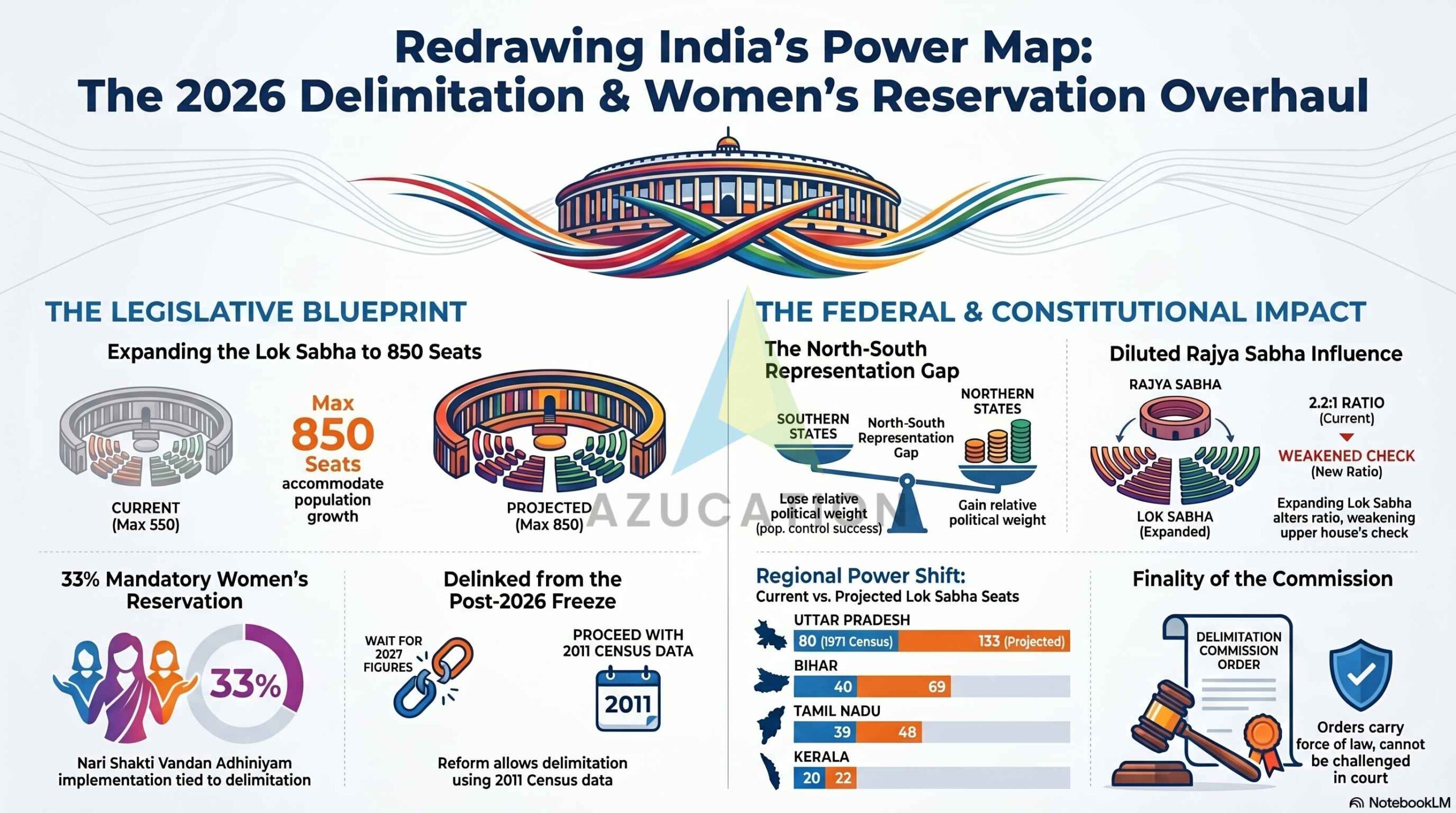
Delimitation debate: How India’s political map could have changed
A long-frozen constitutional mechanism suddenly became the centre of a national political storm in 2026. What looked like a technical exercise of redrawing constituencies quickly turned into a fight over federalism, women’s reservation, state power, democratic equality, and the future balance between North and South in Indian politics.
This is a single-column long-form explainer designed for WordPress pages that already inherit sidebar behaviour from the theme.
Delimitation is not just about lines on a map. It is about who gets how much voice in Parliament. It decides whether a state’s growing population should translate into more Lok Sabha seats, whether states that controlled fertility should lose political weight, whether women’s reservation should wait for a new census-linked exercise, and whether India’s constitutional promise of equal representation can be reconciled with its federal compact.
In one quick summary
- Delimitation means redrawing constituency boundaries and, at the highest level, readjusting seat allocation so representation roughly tracks population.
- India carried out major delimitation exercises in 1952, 1963, 1973 and 2002, but the state-wise allocation of Lok Sabha seats has effectively remained frozen on the old framework for decades.
- The freeze was imposed to ensure states that successfully pursued population control were not politically penalised.
- The 2026 package made delimitation explosive because it was linked to women’s reservation, a possible Lok Sabha expansion up to 850, and a shift in how Parliament could choose the census and timing for the next exercise.
- The package failed in Lok Sabha because the linked constitutional amendment did not secure the required special majority, even though a simple majority was not the problem.
- The bill may have failed, but the underlying issue has only been postponed, not resolved.
What delimitation actually means
In public debate, the word “delimitation” is often used loosely. But there are really three related processes wrapped into it.
The classic democratic argument in favour of delimitation is simple: one person, one vote, one value. If populations shift dramatically but the distribution of seats does not, then the value of representation begins to differ sharply from one state to another.
That is why delimitation is always constitutional before it becomes political, and political before it becomes administrative.
History: how India got here
India did not always treat delimitation as controversial. In the early decades after independence, it was viewed as a normal democratic update after a census. Over time, however, demographic divergence between states turned it into a high-voltage federal issue.
| Year / Phase | What happened | Why it matters |
|---|---|---|
| 1952 | First major delimitation exercise after independence. | Set the initial framework for parliamentary and assembly constituencies. |
| 1963 | Another delimitation round after demographic and administrative changes. | Reflected the evolving map of the republic after state reorganisation and census updates. |
| 1973 | Delimitation based on the 1971 census. | This became the last full benchmark before the long freeze on state-wise seat readjustment. |
| 1976 – 42nd Amendment | State-wise reallocation of Lok Sabha and Assembly seats was frozen. | The stated idea was that states successfully implementing family planning should not be punished with fewer seats. |
| 2001 – 84th Amendment | The freeze was extended till the first census after 2026. | This delayed the next politically sensitive redistribution by another quarter century. |
| 2003 – 87th Amendment | Allowed a partial exercise using 2001 census figures. | Boundaries and SC/ST reserved seats could be updated, but state-wise Lok Sabha seat totals would stay unchanged. |
| 2002 Commission / 2008 orders | The last full commission under the Delimitation Act, 2002 completed orders in 2008. | India updated internal constituency boundaries, but not the inter-state seat balance. |
| 2023 – Women’s Reservation framework | One-third reservation for women in Lok Sabha and State Assemblies was created in principle. | Its implementation was tied to census and delimitation, pulling delimitation back into the centre of politics. |
| 2026 special session | A three-bill package tried to revive delimitation, expand the House, and accelerate women’s reservation. | The package failed, but it forced the country to confront the issue earlier and more sharply than expected. |
This history matters because the current debate is not happening in a vacuum. It is the result of a deliberate constitutional compromise: India chose federal balance over raw demographic arithmetic for decades. The 2026 fight began when it appeared that this bargain might be rewritten.
Why the freeze happened in the first place
By the 1970s, India had already begun seeing differences in fertility and population growth across regions. Southern states moved earlier and more effectively on literacy, public health, urbanisation, and family planning. If seat allocation had continued to follow population mechanically, these states feared they would be penalised for good governance.
So the constitutional system froze the state-wise allocation of seats. The logic was political as much as demographic: a federation cannot remain stable if one set of states feels it is being punished for doing what the Union itself once encouraged.
What the 2026 package tried to change
The 2026 push was not just one bill. It was a three-bill architecture, and that is why the controversy became so large so quickly.
The three-part structure
- Constitution (131st Amendment) Bill, 2026 – the most critical piece, because it sought to amend the constitutional framework governing delimitation and seat readjustment.
- Delimitation Bill, 2026 – the enabling law to constitute a new Delimitation Commission and set out its process.
- Union Territories Laws (Amendment) Bill, 2026 – to carry parallel changes into UTs with legislatures such as Delhi, Puducherry, and Jammu & Kashmir.
What the Constitution Amendment sought to do
The most controversial element was not merely that delimitation would happen. It was that the constitutional bill would have given Parliament greater discretion over when delimitation would happen and which census would be used.
Critics argued that this changed the spirit of Articles 81 and 82. Until now, the constitutional design broadly assumed that representation should be readjusted after each census. The 2026 proposal, according to several critics, shifted that from a more automatic constitutional principle to a matter Parliament could decide by law.
What the Delimitation Bill itself proposed
The Delimitation Bill, 2026 proposed a new Delimitation Commission. Its chairperson would be a serving or former Supreme Court judge, with the Chief Election Commissioner or a nominee and the relevant State Election Commissioner as members. It also provided for associate members from the state’s Lok Sabha MPs and MLAs, though these associate members would not have a vote in the Commission’s decisions.
The Commission would use the latest published census figures available on the date of its constitution. It would determine seat allocation, redraw constituencies, and identify seats reserved for SCs, STs, and women. It would also publish draft proposals, hear objections, hold public sittings, and then issue final orders.
Important process point
The design of delimitation in India is deliberately insulated from day-to-day politics. Drafts are published, objections are invited, and public hearings are held. But once the final order is issued, it carries enormous legal force. Parliament and State Assemblies can receive it, but they do not rewrite it line by line.
Why women’s reservation got pulled into the centre of the storm
The 2023 women’s reservation framework had already made delimitation politically unavoidable because the actual reservation of seats was linked to a future census-linked delimitation exercise. The 2026 package tried to operationalise that sooner by reworking the constitutional sequence.
That was supposed to be the political selling point. Instead, it became the political detonator. Opposition parties said women’s reservation was being used as a shield for a much bigger restructuring of representation.
How India’s political map could have changed
This is the heart of the debate. When people said “India’s political map could change,” they did not mean state borders would be redrawn. They meant the map of representation in Parliament could shift.
Based on PRS projections using 2011 population scenarios, a purely population-based reallocation would have changed the relative weight of many states. The examples below are illustrative projections, not final allocations.
| State | Current Lok Sabha seats | If 2011-based redistribution applied with current-style strength | If House expanded and 2011 shares applied | Broad direction |
|---|---|---|---|---|
| Uttar Pradesh | 80 | 89 | 133 | Strong gain |
| Bihar | 40 | 46 | 69 | Strong gain |
| Rajasthan | 25 | 30 | 46 | Gain |
| Madhya Pradesh | 29 | 32 | 48 | Gain |
| Maharashtra | 48 | 50 | 75 | Gain |
| Tamil Nadu | 39 | 32 | 48 | Absolute rise only if House expands, but share shrinks |
| Kerala | 20 | 15 | 22 | Sharp share loss |
| Karnataka | 28 | 27 | 41 | Small relative erosion |
| Andhra Pradesh | 42 | 38 | 56 | Share decline |
| Odisha | 21 | 19 | 28 | Share decline |
These figures are illustrative readings from public projections around the 2011-census-based debate and show why the conversation moved from “technical” to “existential” for many states.
Why both sides cited different numbers
One reason the debate became even more confusing is that two different political narratives ran side by side.
- The fear narrative: If seat allocation followed population strictly, southern states would lose share and northern states would gain clout.
- The government reassurance narrative: The House could be expanded in a way that every state gained seats, preserving present share or at least preventing any immediate absolute loss.
That is why some public explanations spoke of Tamil Nadu dropping from 39 to 32, while others spoke of Tamil Nadu rising to around 58 if a uniform 50% expansion preserved current ratios. The political distrust came from one central question: what exactly was guaranteed in law, and what was only being politically promised?
The deeper fear was not just seat loss
For many critics, the immediate seat arithmetic was only half the issue. The larger fear was that once Parliament got discretion over timing and census choice, the rules of future redistributions could become politically negotiable in a way they had never been before.
Why the issue became politically explosive
1) The South felt it was being punished for success
Tamil Nadu, Kerala, Karnataka, Andhra Pradesh and, to varying degrees, other relatively lower-fertility regions have long argued that they implemented family planning, improved social indicators, and stabilised population earlier than many northern states. If the reward for that is a shrinking share of seats in Lok Sabha, the message appears perverse: govern better, lose political influence.
2) It raised a federalism question, not just an electoral one
In a union as diverse as India, Parliament is not merely a body of numerical headcount; it is also the arena where states negotiate power. Once a few very large states gain much more weight, smaller or slower-growing states worry that the Union compact itself changes in spirit, even if the Constitution remains formally intact.
3) It could alter national party incentives
If the largest seat gains come from states where one party is already dominant, the opposition will naturally ask whether delimitation is being proposed in the name of democratic equality but designed to alter long-term political advantage. That suspicion became central to the 2026 vote.
4) Women’s reservation was linked to a much larger structural fight
Broad political support existed for increasing women’s representation. But once women’s reservation was tied to delimitation, opponents argued that the aspirations of women were being made contingent on agreement over one of the most divisive questions in Indian federal politics. In simple terms: the country was asked to swallow an entire constitutional package in order to speed up one reform many already supported.
5) There were concerns about future discretion
Critics were not only worried about the 2026 plan. They were worried about precedent. If Parliament could later decide when to delimit and which census to use, then the process could become more politically strategic than constitutionally automatic.
6) OBC representation and caste-census concerns added another layer
Another opposition argument was that a delimitation-and-quota package built around older population data could sidestep a fuller caste-based representation conversation. In political debate, this became part of the broader charge that the government was trying to redesign representation without first resolving the social-justice questions beneath it.
Why it failed to get the numbers in Lok Sabha
This part is crucial because many readers ask: If the government had a majority, why did the bill fail?
Because the key bill needed more than a simple majority
The constitutional amendment was not an ordinary bill. It required a special majority in Parliament. In the Lok Sabha vote, 528 members were present and voting. That meant the government needed 352 votes. It got 298 in favour and 230 against.
Why the numbers were not enough
- A constitutional amendment cannot pass merely because “ayes” are more than “noes.”
- The opposition largely united against the package.
- Many opponents said they were not against women’s reservation; they were against tying it to delimitation and future parliamentary discretion.
- Once the constitutional bill failed, the linked delimitation architecture could not move forward in the intended form.
So why exactly did MPs vote against it?
- They saw it as delimitation through the back door. Opposition leaders argued the package was less about women and more about altering electoral geography.
- Southern states mobilised strongly. Their core argument was that demographic discipline should not lead to democratic downgrading.
- The legal drafting itself caused distrust. Critics said the bill did not sufficiently hard-wire the political assurances being publicly made.
- The package bundled too much together. Women’s reservation, delimitation, census choice, House expansion and UT changes were all tied into one confrontation.
- The government lacked the cross-party consensus needed for a constitutional rewrite. Delimitation may be constitutional law, but it cannot survive politically without broad trust.
In effect, the Lok Sabha did not reject the need to revisit representation forever. It rejected this route, this timing, and this package.
Larger constitutional questions beyond seat counts
The debate was never only about whether Uttar Pradesh gains or Tamil Nadu loses. PRS and other analyses pointed to larger structural consequences that deserve far more public discussion.
A much larger Lok Sabha changes Parliament itself
Expanding Lok Sabha from the present framework toward a ceiling of 850 would not be a cosmetic reform. It would alter the internal balance between Lok Sabha and Rajya Sabha, strengthen the lower house in joint sittings, and reduce the relative weight of the upper house in some institutional contexts.
It could also indirectly enlarge executive power
Since the size of the Union Council of Ministers is capped as a percentage of Lok Sabha strength, a much larger House could raise the permissible number of ministers. That may sound administrative, but it goes to the heart of executive accountability and coalition management.
More MPs does not automatically mean better deliberation
A larger House also means each MP may get less time to speak, fewer opportunities to raise questions, and a lower probability of being picked in ballot-based procedures. In other words, numerical inclusion may come at the cost of deliberative space unless parliamentary rules are redesigned too.
Representation is not just arithmetic; it is also trust
India’s founding constitutional design tried to keep democratic equality and federal balance in the same frame. Delimitation exposes the fact that these two values do not always pull in the same direction. Equal population representation may demand one answer. Stable federal politics may demand another.
The hardest constitutional question of all
Should India treat Parliament primarily as a body that mirrors population, or as a democratic-federal arrangement in which states must also feel secure regardless of demographic divergence? Delimitation is where that question becomes unavoidable.
What happens next
The defeat of the 2026 package did not end the issue. It merely delayed the moment of decision.
1) The census remains the first practical obstacle
Without fresh published census figures, the constitutional trigger for the next stage cannot operate in the conventional way. The delay of the census already means that completing a full delimitation before the 2029 general election is uncertain.
2) India may now move toward negotiation instead of unilateral design
Because the government failed to build the supermajority required, any future attempt may need a more negotiated formula. That means the next round could look less like a direct push and more like a political settlement.
3) Several future pathways are now possible
This would preserve the current federal balance for longer, but it would also deepen the democratic argument that some votes effectively carry less parliamentary value than others.
Politically, this may be the easiest compromise because every state gains absolute seats. But critics may still question whether this merely postpones the harder issue.
India could search for a middle path that includes population but also gives weight to factors such as federal balance, governance outcomes, or floor protections for states.
This is what many opposition parties demanded: implement women’s reservation within the existing structure and fight the delimitation battle separately.
This would satisfy the strongest democratic-equality argument, but only if accompanied by constitutional and political safeguards that smaller or slower-growing states can accept.
4) The issue will come back before 2029 or soon after
Even if no immediate bill succeeds, India cannot permanently avoid the mismatch between its population map and its parliamentary map. The longer the country waits, the sharper the eventual adjustment may become.
5) Future debate will likely be wider than just Lok Sabha seats
The next serious conversation may also involve Rajya Sabha balance, presidential electoral arithmetic, assembly seat implications, SC/ST and women’s reservation design, and the broader question of whether a growing India needs a new parliamentary architecture altogether.
Final word
My reading of the issue
The delimitation debate is difficult because both sides are holding one important truth.
The first truth is democratic: if populations change dramatically, representation cannot remain frozen forever. A citizen’s vote should not become permanently less valuable simply because the system stopped updating.
The second truth is federal: a union cannot remain politically healthy if states believe they are being punished for better social outcomes, or if a few giant states begin to overshadow the rest of the country in a way that weakens the spirit of the federation.
That is why delimitation is not a battle between right and wrong. It is a battle between two legitimate constitutional instincts — democratic equality and federal fairness.
The 2026 package failed not because India can avoid this issue, but because the country does not yet trust one side to settle it alone. The next attempt, whenever it comes, will need more than numbers in Parliament. It will need a formula that feels constitutionally fair, politically credible, and regionally respectful.
India’s political map may not have changed in 2026. But the debate has already changed the way the country thinks about representation. And that means the real delimitation battle is still ahead.
Frequently asked questions
What is the simplest definition of delimitation?
It is the process of redrawing electoral constituencies and, where applicable, readjusting the distribution of seats so representation better reflects population and constitutional requirements.
Why are southern states worried about delimitation?
Because if Lok Sabha seats are redistributed strictly by population, states that stabilised population earlier may lose share in Parliament relative to faster-growing states. Their argument is that this punishes developmental success.
Was the 2026 debate only about women’s reservation?
No. Women’s reservation was the political entry point, but the larger controversy was about representation, seat redistribution, House expansion, census choice, and future parliamentary discretion.
Why did the bill fail despite a majority supporting it?
Because the key constitutional amendment required a special majority, not just more votes in favour than against. The government got 298 votes, but needed 352 because 528 members were present and voting.
Does the failure mean delimitation is over?
No. It means the proposed route failed. The underlying constitutional problem remains unresolved and will almost certainly return with the census and future electoral reform discussions.
Could India expand Lok Sabha without reducing any state’s absolute seats?
Politically yes, that was one of the compromise ideas publicly floated. But critics argued that the legal text did not clearly guarantee the same comfort level they were being asked to trust politically.