


 AzuCATion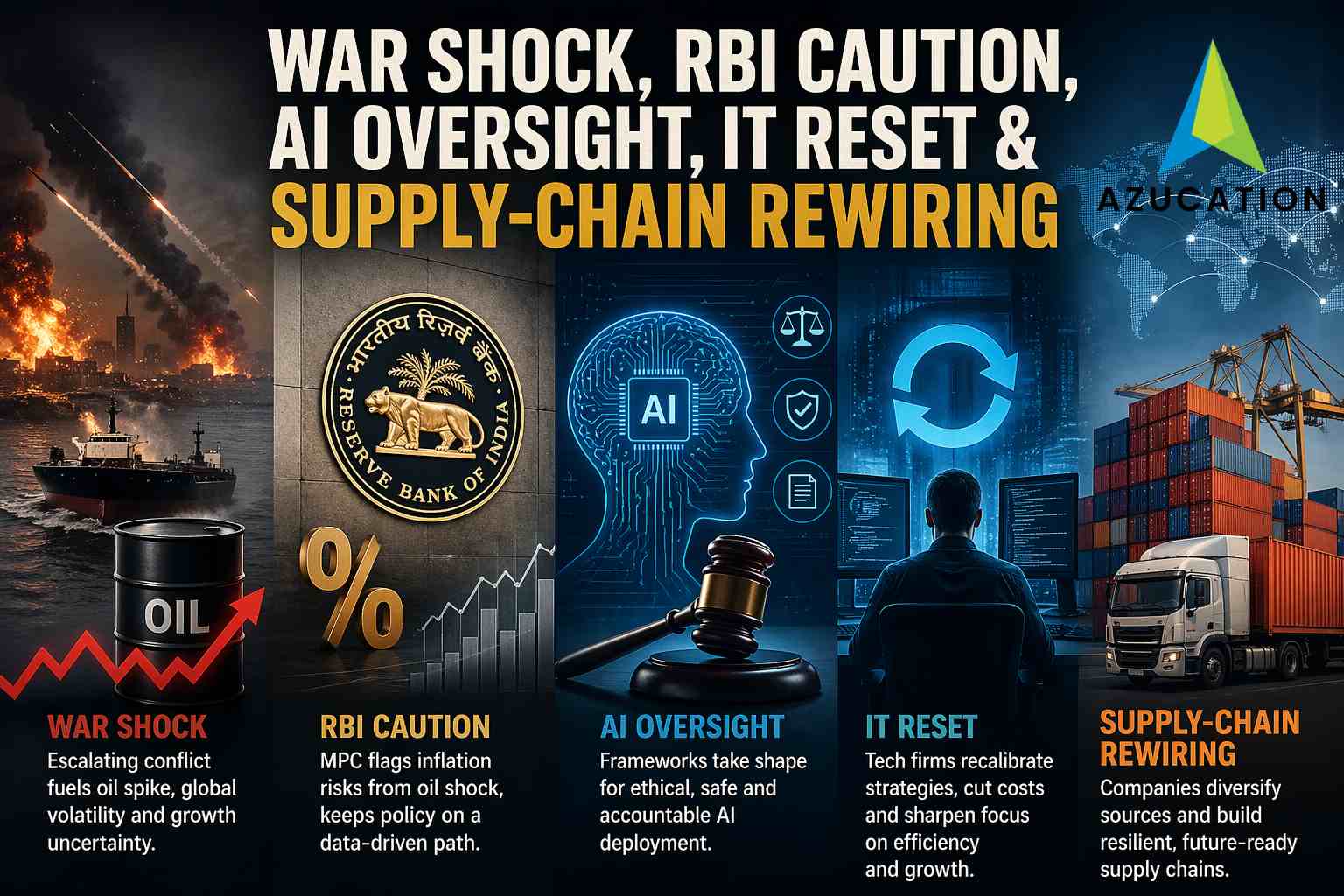
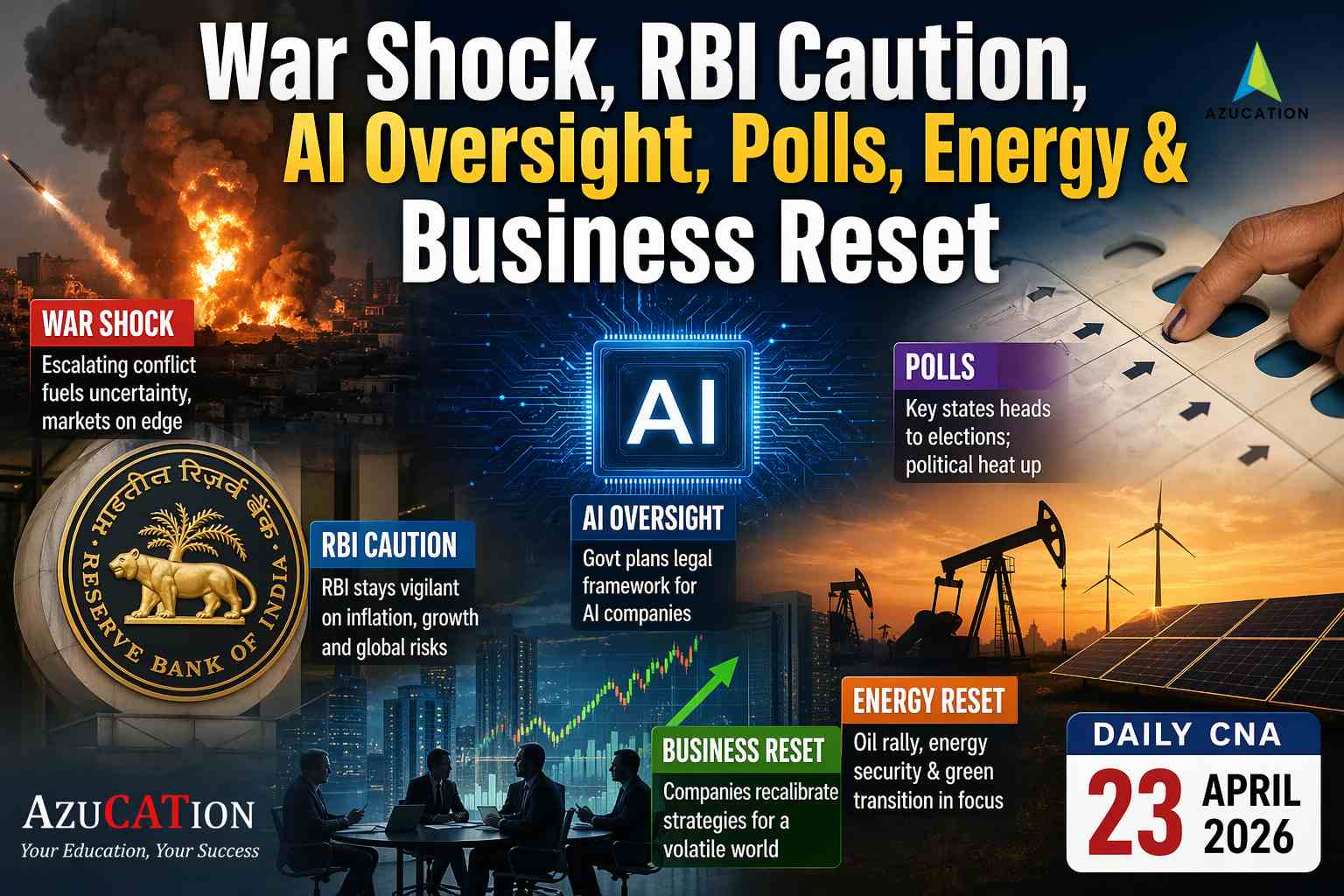
War Shock, RBI Caution, AI Oversight, IT Reset & Supply-Chain Rewiring
Today’s news flow is about one big idea: uncertainty is no longer temporary background noise. Energy shocks, AI-driven cyber risk, elections, weak global demand, supply-chain redesign and employment pressure are now shaping how governments, firms and consumers make decisions.
The dominant theme today is resilience under stress. India’s macro story remains strong, but it is now being tested by crude oil volatility, rupee weakness, input shortages, AI risk, global trade uncertainty and job-market recalibration.
For MBA aspirants, this is a perfect GD-PI day because it connects macroeconomics, central banking, cybersecurity, corporate strategy, technology employment, supply chains, public finance and electoral behaviour in one integrated framework.
Quick Navigation
West Asia war has turned from a geopolitical headline into a macroeconomic test
RBI’s warning is clear: supply disruption can become demand shock if energy and trade stress persist.
The RBI’s State of the Economy article warns that the West Asia conflict has changed the global macro environment through supply-chain disruption, higher energy costs and financial-market volatility. India is not as externally fragile as many economies, but it cannot remain untouched when crude, freight, currency and input markets become unstable.
The important phrase for interviews is second-round effects. A one-time oil spike can be absorbed. But if the spike continues, transport, logistics, fertilisers, pharma inputs, electricity costs and household budgets begin to adjust. That is when a supply shock starts affecting demand.
A country can handle volatility if it has buffers: forex reserves, foodgrain stocks, fiscal space, diversified suppliers, power capacity and credible monetary policy. Today’s news tests all these buffers together.
Fuel prices are politically frozen, but economic pressure is visible
The government denied immediate petrol-diesel hike reports, yet OMC under-recoveries show the stress underneath.
The fuel story is a classic case of economic pressure meeting political sensitivity. Reports of a post-election fuel price hike were dismissed as fake news, but officials also acknowledged that state-run oil marketing companies are facing large under-recoveries because retail prices have stayed stable while crude oil has surged.
For consumers, stable pump prices reduce immediate inflation pain. For oil companies, this means margin pressure. For government, it creates a trade-off: protect households now, or restore OMC profitability later. For RBI, the risk is that suppressed prices may delay inflation, not eliminate it.
Administered or politically managed prices can soften public pain in the short run, but they create hidden fiscal, corporate and inflationary trade-offs.
Claude Mythos shows why AI governance is now financial stability policy
Finance ministry asked banks to strengthen cyber defences and build faster threat-intelligence sharing.
AI is no longer only a productivity theme. The discussion around Claude Mythos and advanced cyber-capable AI models shows that AI can also become a systemic risk. If AI tools can find software vulnerabilities faster than human teams, banks must shift from periodic audits to continuous monitoring.
Finance minister Nirmala Sitharaman asked banks to take pre-emptive steps, engage specialised cyber experts and improve coordination with CERT-In and other agencies. This matters because banking trust depends not just on capital adequacy but also on digital security.
A modern bank run may not begin with depositors standing outside branches. It may begin with a breach of trust in digital systems.
- AI can help banks detect fraud and vulnerabilities faster.
- The same AI can also be misused to weaponise software weaknesses.
- Financial stability now requires cybersecurity capacity, regulatory coordination and sovereign digital resilience.
Infosys beats estimates, but IT’s old growth model is under pressure
The headline profit number looks strong; the deeper story is weak guidance, AI compression and slow hiring.
Infosys reported strong Q4 numbers, with revenue and profit growth beating expectations. But the company also guided cautiously for FY27 because West Asia uncertainty, AI-driven productivity gains, vendor consolidation and client spending delays are changing the IT services equation.
The bigger employment angle is even more important. The top five Indian IT services companies saw net headcount decline in FY26. TCS reduced headcount sharply, while Infosys maintained fresher hiring plans. This shows that the sector is not disappearing, but the relationship between revenue growth and employee growth is weakening.
AI may not kill IT services, but it will change billing models, entry-level hiring, training, utilisation and the meaning of productivity.
Apple’s India shift is a supply-chain victory, but not yet a value-addition victory
India has overtaken Vietnam in Apple supplier count, while reducing Chinese supplier dependence.
Apple’s supplier base in India has risen sharply, and India has reportedly overtaken Vietnam in the total number of Apple suppliers. More importantly, India has reduced its dependence on Chinese suppliers to below 10% in Apple’s local ecosystem.
But the story is not only about supplier count. The harder question is value addition. If critical components, capital, technology and scale remain weak, India can assemble more without capturing enough value. For GD-PI, this is a balanced answer: India is winning supply-chain diversification, but must deepen component capability.
“China-plus-one” is an entry door. To convert it into long-term manufacturing power, India needs component depth, lower capital cost, skilled suppliers and faster technology absorption.
High voter turnout and panchayat finance both point to deeper grassroots participation
Tamil Nadu and West Bengal saw record participation, while panchayats are being nudged to raise own-source revenue.
Record turnout in Tamil Nadu and West Bengal shows that electoral participation remains intense in state politics. High turnout often indicates mobilisation, anti-incumbency energy, identity consolidation or competitive political stakes. It does not automatically predict outcome, but it signals that voters are engaged.
At the governance level, the panchayat finance story is equally important. Several gram panchayats are raising own-source revenue through property tax, water charges, toll auctions, local rentals and community contributions. The 16th Finance Commission’s grant design is also pushing local bodies towards financial self-reliance.
Decentralisation is meaningful only when local governments have both responsibility and revenue capacity. Otherwise, they remain dependent administrative units.
Steel prices, wheat exports and manufacturing PMI show the real economy is still moving
Even amid war stress, domestic demand, manufacturing output and commodity cycles remain active.
Mint’s primer shows steel firms may post a strong Q4 because prices recovered sharply from November lows. Rebar and HRC prices rose on stronger demand, safeguard protection and pre-monsoon construction activity. But the rally may soften by monsoon as construction slows.
Manufacturing PMI also recovered in April, with HSBC Flash Composite PMI rising to 58.3. At the same time, wheat stocks and export policy show how agriculture buffers can be used to support farmer prices without endangering food security, if calibrated carefully.
India’s real economy is not frozen by global uncertainty. It is adjusting sector by sector: steel benefits from construction, manufacturing rebounds, wheat exports manage surplus, while fuel and fertiliser-linked sectors face cost stress.
GD-PI Interview Angles
Use these as 60–90 second answer frameworks.
1. Can India remain resilient if oil stays high?
Yes, because of forex reserves, domestic demand and policy buffers; but high crude affects CAD, inflation, OMC finances and household consumption if prolonged.
2. Is AI good or bad for banking?
Both. It improves fraud detection and productivity, but also increases cyber risk. The answer is not banning AI, but building audited, coordinated and real-time defence systems.
3. Will AI reduce IT jobs?
It will reduce some entry-level repetitive work and change hiring patterns, but it can create higher-value AI transformation work if firms reskill fast.
4. Is Apple’s India supply chain a success?
It is a major start in supplier diversification, but the next goal must be deeper component manufacturing and higher value addition.
WAT Themes for Practice
Write 250–300 words on any one.
- Energy security is now central to economic security.
- AI in finance: opportunity, threat or regulatory challenge?
- India’s manufacturing rise depends on value addition, not assembly alone.
- Should governments freeze fuel prices during global crises?
- Local self-government needs fiscal freedom, not just administrative responsibility.
- Does high voter turnout always mean political change?
Best revision line: In volatile times, resilience is not the absence of shocks; it is the ability to absorb them without losing direction.
RC Practice Quiz: Resilience in a Shock Economy
Passage
Modern economies face a new kind of uncertainty. Earlier, governments could treat geopolitical shocks, technology change and market volatility as separate problems. Today, they overlap. A war can raise oil prices, which can affect inflation, fiscal policy, corporate margins and household demand. AI can improve productivity, but it can also expose banking systems to new vulnerabilities. Supply-chain diversification can reduce dependence on one country, but it does not automatically create deep domestic capability.
For emerging economies, resilience therefore depends on the quality of institutions. Central banks must read whether a shock is temporary or persistent. Governments must protect consumers without hiding economic costs forever. Companies must invest in technology while managing employment transitions. Local bodies must raise revenue without losing public trust. In such an environment, the best policy response is rarely a single dramatic move; it is coordinated, data-driven and adaptive governance.
Want daily CNA, mock tests, profile help and GD-PI preparation?
AzuCATion is building serious MBA preparation around current-affairs interpretation, interview articulation, profile strategy, practice tests and grounded mentoring.
How to use this page smartly: Read the seven core themes, speak for 60 seconds on any two, attempt the RC quiz, then write one WAT answer from memory.
Best revision line for the day: The strongest economies are not shock-free; they are system-rich.