


 AzuCATion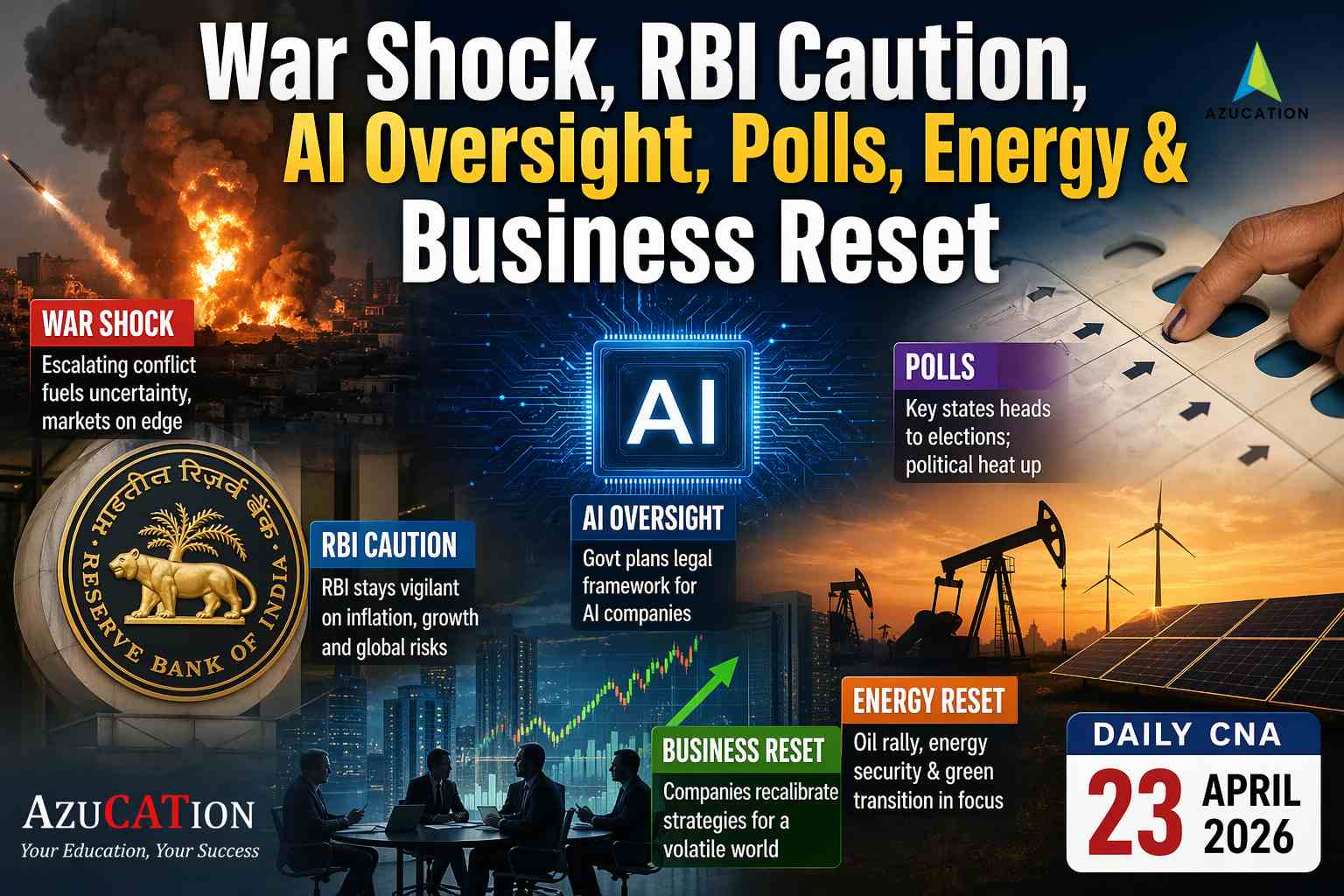
War Shock, RBI Caution, AI Oversight, Polls, Energy & Business Reset
The biggest lesson from today’s news cycle is that India is being tested on three fronts at once: external shocks, domestic institutional capacity, and business adaptation speed. When war disrupts oil, logistics and confidence, the real question is not whether one headline is negative. The real question is whether the system can absorb shock without losing growth, trust and policy clarity.
A common thread runs across today’s developments. Whether the issue is RBI’s new e-mandate framework, the central bank’s careful rate stance, India’s possible rethink on AI regulation, or even the push for high-blend ethanol and flex-fuel engines, the state is trying to move from reactive management to rule-based resilience.
For MBA aspirants, this is a very strong interview day because it lets you connect macro policy, consumer protection, energy security, elections, digital regulation, business model stress, and competitive strategy in one answer. Panelists love such days because they reveal whether you think in silos or in systems.
Quick Navigation
RBI’s e-mandate clean-up is a small-looking reform with big trust value
Recurring payments work only when convenience does not come at the cost of consent, transparency and reversibility.
One of the most quietly important stories today is RBI’s consolidated framework on e-mandates. These are the recurring payment permissions used for subscriptions, mutual fund SIPs, insurance premiums, utility bills and loan instalments. At first glance this feels like a narrow payments update. It is not. It is actually a consumer trust architecture story.
The problem with many auto-debit systems is not automation itself. The problem is that users often feel trapped by confusing cancellation processes, weak advance warnings or surprise debits. RBI’s revised framework tries to correct this by clearly defining the mandate lifecycle: registration with authentication, advance alerts, flexible modification, easy withdrawal, and grievance handling.
In digital finance, trust is not built only by low friction. It is built by reversible consent. When users know they can stop, modify or monitor a recurring payment, they are more willing to adopt the system at scale.
The revised rules also show an important regulatory balancing act. RBI does not want to kill convenience. That is why certain essential categories such as insurance premiums, mutual fund subscriptions and credit card bill payments can continue under special conditions and higher thresholds. But RBI also does not want “convenience” to become an excuse for sloppy customer rights. So it has consolidated earlier fragmented rules into a single clearer framework.
The MBA angle here is powerful: good regulation can expand markets. When rules reduce complaints and uncertainty, usage can actually rise. This is true in payments, insurance, credit and even AI products. Markets grow faster when users believe the system is on their side.
Whenever a regulator simplifies rules while preserving user rights, it often improves both adoption and compliance. That is classic institutional market design.
War-driven supply shock is forcing RBI to stay cautious — and LPG stress makes the shock real at the household level
The central bank can manage expectations, but it cannot manufacture supply. That is why today’s macro story is about judgment, not activism.
Mint’s macro coverage today shows a very clear message from RBI’s April minutes: the current inflation risk is being seen largely as a supply-led shock. That matters because central banks are effective against demand overheating, but much less effective against war-driven oil spikes, shipping bottlenecks or geopolitical supply disruption.
This is why the Monetary Policy Committee appears to be in a wait-and-watch mode. It does not want to overreact to a temporary shock, but it also cannot ignore the risk that temporary shocks become permanent in the minds of firms and consumers. Once that happens, wage expectations, pricing behaviour and long-term inflation assumptions start shifting. That is when a supply shock becomes a broader macro problem.
The sharp interview line for today is this: RBI is not fighting current inflation alone; it is trying to prevent future inflation psychology.
The LPG story makes this abstract policy debate concrete. New cooking gas connections have reportedly been paused amid supply stress linked to the West Asia conflict and disruption around the Strait of Hormuz. India depends heavily on imported LPG, especially from West Asia. So when supply lanes get strained, the pain travels quickly from geopolitics to the kitchen.
This also explains why policymakers are simultaneously discussing energy diversification, PNG expansion, flex-fuel adoption, and strategic buffers. India’s resilience is not just about maintaining GDP growth. It is about reducing the number of everyday economic channels through which external shocks hurt households.
War → oil and shipping uncertainty → supply disruption → household fuel stress and firm input cost pressure → inflation expectations risk → RBI caution. That full chain is the real story.
Strong managers distinguish between price shocks, supply shocks and sentiment shocks. The correct response differs for each. Today’s central lesson is that policy credibility matters most when tools are limited.
India may move away from light-touch AI oversight — and gaming rules show that digital regulation is hardening
The state is signalling that scale technologies will not be left to self-discipline alone, especially when they affect money, misinformation, public systems and user safety.
Two stories belong together today. First, Mint reports that the Centre may rethink its earlier light-touch AI governance approach and could move toward a more prescriptive framework. Second, the government has firmly notified rules that keep online real-money gaming banned, while allowing non-monetary categories to operate under a lighter structure.
The unifying idea is simple: as digital products become more consequential, the state is less comfortable relying only on principles and voluntary signalling. AI now intersects with finance, public services, defence, jobs, misinformation, cyber-risk and critical infrastructure. Real-money gaming intersects with financial loss, addiction, payment flows and consumer vulnerability. In both cases, the government is drawing a sharper regulatory boundary.
India is not rejecting innovation. It is moving toward the position that innovation at scale must be governable. That is a major strategic shift from “build first, regulate later” thinking.
The ET editorial idea on constant AI labelling adds another layer. Label-heavy compliance may sound attractive, but badly designed labelling can create fatigue, cosmetic compliance or ambiguous accountability. This is a useful MBA-style reminder: not every visible control improves outcomes. Good governance needs clear objectives, good auditability and low-ambiguity enforcement.
For interviews, avoid the lazy answer that “more regulation is good” or “less regulation is good.” The better answer is: regulation should be proportionate to risk, adaptable to technology speed, and strictest where asymmetry and public harm are highest.
- AI oversight is moving from advisory thinking toward sector-linked accountability.
- Gaming rules show the state is willing to separate acceptable digital entertainment from high-risk digital behaviour.
- Future digital winners may be firms that build compliance readiness into product design, not as an afterthought.
In emerging sectors, the most valuable capability is often not just innovation. It is regulatory adaptability — the ability to scale while staying acceptable to the state, the market and the public.
State polls in Tamil Nadu and West Bengal are about more than votes — they are tests of federal politics, welfare economics and administrative trust
Election stories matter for MBA interviews because they reveal how economics, identity, incentives and delivery systems interact in real life.
Polling in Tamil Nadu and West Bengal is one of today’s most politically charged stories. But beyond party arithmetic, these elections are useful because they reveal how Indian states compete through welfare promises, political identity, leadership branding and federal bargaining power.
West Bengal remains a story of long incumbency versus challenger momentum, while Tamil Nadu remains a story of regional political structure where national parties still struggle to dominate. For business students, the deeper lesson is that Indian politics is not a uniform national market. It is a collection of regional operating systems.
The freebies debate should also be handled intelligently. It is easy to dismiss all transfers as fiscally irresponsible. But a mature answer distinguishes between productive welfare, consumption support, and purely political giveaways. A scholarship, a health transfer or employment-linked support can have different long-term economic value than a short-term distribution meant mainly for votes.
Do not say, “freebies are bad.” Say: welfare quality depends on design, targeting, funding sustainability and whether it builds future capability.
ET’s coverage around defence cooperation with Germany also matters here because elections and geopolitics often shape industrial policy. Defence partnerships, semiconductor ambitions, AI capability and energy resilience increasingly overlap with political narratives about national capacity. Modern politics is no longer separate from economic strategy; it is one of its delivery vehicles.
Sugar, ethanol, tolling and pensions: today’s policy mix shows India is redesigning operating systems, not just announcing schemes
The most overlooked reform stories are often the ones that change incentives and process discipline at the ground level.
Several seemingly unrelated policy stories actually fit together well today. The proposed revamp of the decades-old Sugarcane Control Order aims to tighten farmer payment discipline through penal interest for delayed mill payments. The push for higher ethanol blends and flex-fuel engines is about reducing fuel vulnerability while supporting an alternative energy pathway. The move to de-risk barrier-free tolling is about maintaining investor confidence while upgrading transport efficiency. And the possible increase in the assured pension ceiling under Atal Pension Yojana is an attempt to improve retention and relevance for informal workers.
These stories belong to the same policy family: make systems more rules-based, digitally trackable and incentive-compatible. Delayed sugarcane payments hurt farmers because contracts are weakly enforced. Barrier-free tolling sounds modern, but private operators worry about leakage and revenue uncertainty. Pension schemes attract sign-ups, but retention collapses if long-term value looks too low. Good policy solves these frictions by changing incentives, not by issuing motivational speeches.
India’s next stage of reform is increasingly about execution architecture: better enforcement, better compensation logic, better digital reporting and better incentive alignment.
The ethanol story is especially important in the current geopolitical setting. When the external energy environment is unstable, domestic blending targets become more than environmental goals. They become tools of strategic resilience. But this must be assessed carefully too: land use, crop mix, water intensity and food-fuel trade-offs remain real concerns.
A very good MBA answer here balances ambition and realism. Yes, higher blending and sustainable aviation fuel can reduce import vulnerability. But no, every energy transition is not automatically efficient or socially neutral. Strategy must still be evaluated against cost, resource intensity and alternative uses.
- Sugar reform improves payment discipline and reduces farmer vulnerability.
- Ethanol expansion links agriculture, energy and industrial policy.
- Barrier-free tolling shows tech adoption needs business-risk sharing.
- APY changes show financial inclusion is not only about enrolment but persistency.
- Digital reporting and APIs are increasingly becoming governance tools.
- Infrastructure reform succeeds only when commercial incentives stay viable.
Markets are rewarding execution and punishing weak transition stories
Today’s corporate stories show that investors are no longer satisfied with narratives alone; they want proof that strategy can survive volatility.
The business and markets section today is especially rich. HCLTech faced pressure after weak Q4 numbers and soft FY27 guidance. The market reaction is not just about one quarter. It reflects concern over whether HCL can justify a premium valuation if its growth edge over peers narrows. The company is betting that advanced AI services and AI-native opportunities will help cushion the transition, but investors clearly want evidence, not just positioning.
This is a valuable corporate strategy lesson. In periods of technological change, companies often face a dangerous middle phase: the old business is slowing faster than the new business is monetising. That transition gap can compress margins, deal values and market confidence.
The market is most unforgiving when a firm says, “our future story is strong,” but the present numbers suggest that the bridge to that future is weak.
The same broad theme appears elsewhere too. Bira’s founder exit under restructuring pressure, PMS scale hurting alpha, and insurance JVs like Jio Financial–Allianz all point to the same truth: capital now prefers disciplined models, clear governance, robust distribution and execution credibility.
ET’s market pages also show a wider anxiety about AI-led disruption in IT and about macro downside-upside risks under war conditions. This means the market is simultaneously repricing technology transition risk and macro uncertainty. That combination usually raises the premium on clarity, cash flow quality and business resilience.
Strategy is not judged only by where a firm wants to go. It is judged by whether the firm can finance, execute and communicate the journey credibly.
GD-PI / Interview Zone
Use these to convert news into structured answers.
1. Why is RBI in wait-and-watch mode despite inflation risk?
Because the current risk is largely supply-led. Aggressive rate action cannot create oil, shipping access or LPG supply. RBI’s main job is to stop second-round inflation expectations from getting entrenched.
2. Is stronger AI regulation anti-innovation?
No. Smart regulation can increase adoption by reducing trust deficits. The key is proportionate and risk-based governance, not blanket overreach.
3. Are freebies always bad economics?
Not necessarily. The correct distinction is between productive welfare, social protection and politically motivated giveaways. Design and fiscal sustainability matter.
4. What does the LPG story tell us about India’s energy challenge?
It shows how external dependence turns geopolitical shocks into household-level stress. That is why diversification, blending, PNG and strategic planning all matter.
5. Why did HCLTech get punished so sharply?
Because the market fears that its premium valuation may not be justified if growth leadership weakens and AI transition benefits take time to show up in core numbers.
6. What is the common theme across today’s policy stories?
India is trying to build resilience through better rules, clearer data systems, stronger user protection and more credible operating frameworks.
WAT / Essay Themes for Today
Good WAT answers should balance principle, practicality and trade-offs.
Should fast-growing technologies like AI be governed through light-touch rules or strict accountability frameworks?
Build around innovation, user harm, sector risk, enforcement capacity and international competitiveness.
Can India remain growth-resilient when external shocks keep hitting oil, logistics and trade routes?
Use domestic demand, buffers, diversification, inflation expectations, and energy transition in your structure.
Do welfare transfers strengthen democracy or weaken fiscal discipline?
Best answers will distinguish safety nets from vote-maximising giveaways and discuss targeting, productivity and sustainability.
In the digital economy, is trust built more by convenience or by control?
Use the e-mandate framework, gaming rules and AI oversight to argue that users adopt systems more deeply when they retain rights and visibility.
Reading Comprehension Mini Quiz
Passage
External shocks do not damage economies only through the first and most visible channel. A rise in oil prices or a disruption in shipping lanes may initially look like a supply problem, but the deeper risk lies in the way firms, households and markets reinterpret that shock. Businesses may pass on higher costs more aggressively, workers may begin to expect persistent inflation, consumers may postpone purchases, and investors may cut risk. At that point, the original shock stops being just a temporary disturbance and begins to alter behaviour across the system.
This is why policymakers often appear cautious during geopolitical crises. Doing too little can allow expectations to drift; doing too much can suppress already fragile demand without solving the supply problem. The challenge is not merely to react to the shock, but to prevent its psychological and financial transmission. In such environments, credibility, communication and institutional design become as important as direct intervention.
1. According to the passage, the deeper risk of an external shock is that it:
2. Why might policymakers avoid an overly aggressive response to a supply shock?
3. Which of the following best captures the main idea of the passage?
AzuCATion MBA Prep Note
Today’s CNA is ideal for converting headline knowledge into high-quality interview answers. Practice building one 60-second answer on macro policy, one on AI governance, one on elections and welfare, and one on business strategy under uncertainty.
How to use this page: First read the hero summary, then revise the six stories, then practice the GD-PI answers, and finally write one WAT introduction from any of the themes above.
This page is intentionally designed in a clean single-column format for easy blog publishing, reading and mobile use.