


 AzuCATion
Paytm Licence Shock, RIL Energy Hit, IT Selloff, AI Oversight & Trade Reset
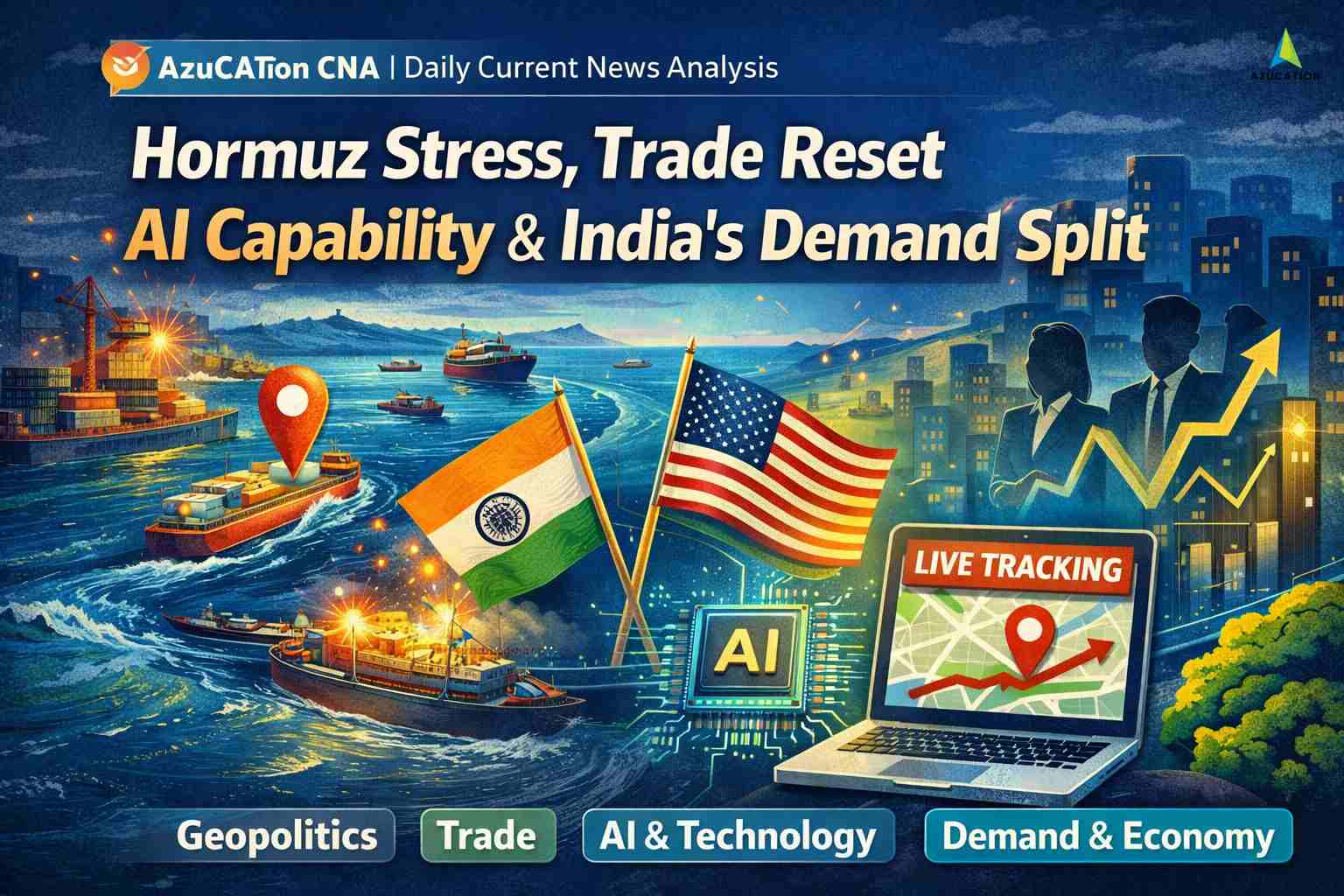
Today’s CNA is built around one big idea: uncertainty is no longer only geopolitical. It is entering balance sheets, banking supervision, technology hiring, aviation security, supply chains, household behaviour and market valuations. For MBA aspirants, this is a perfect day to practise integrated business thinking.
The strongest way to read today’s news is through the lens of institutional stress testing. RBI is stress-testing fintech governance, companies are stress-testing supply chains, markets are stress-testing IT valuations, the government is stress-testing education-to-employment linkages, and businesses are stress-testing AI risks.
For GD-PI, do not memorise these as separate news items. Connect them into one larger argument: India’s growth story remains strong, but the next phase will depend on governance quality, energy resilience, cyber preparedness, skilled labour and credible market institutions.
Quick Navigation
RBI cancels Paytm Payments Bank licence: fintech innovation meets regulatory finality
The headline is not just about one firm. It is about trust, compliance and the limits of platform-led banking.
The Reserve Bank of India cancelled Paytm Payments Bank’s banking licence with effect from close of business on 24 April 2026, citing depositor interest and the manner in which the bank’s affairs were conducted. The bank is now prohibited from carrying on the business of banking, and the regulator will seek winding up through the High Court.
This is a landmark story because payment banks were created to expand financial inclusion through digital-first, low-risk deposit-taking models. They could accept deposits but could not lend. The logic was simple: reduce systemic risk while increasing access. But the Paytm PB episode shows that even a limited banking model can become a serious governance issue if compliance, KYC, related-party boundaries and operational discipline are weak.
Fintech firms win users through speed, convenience and scale. Banks survive through trust, auditability and regulatory comfort. The Paytm PB case reminds us that financial innovation without institutional discipline is not sustainable.
For interviews, avoid saying “RBI is anti-innovation.” A stronger answer is that regulators usually support innovation when consumer protection, deposit safety and systemic trust are not compromised. The cancellation is a signal that the Indian fintech sector must mature from growth-first execution to governance-first execution.
The future of fintech is not only about UX, QR codes and customer acquisition. It is about compliance architecture, risk management, board independence, data governance and consumer trust.
RIL’s Q4 shows how West Asia risk travels into Indian corporate earnings
Energy disruption is no longer a background variable. It is now visible in profit, margins, shipping costs and investor sentiment.
Reliance Industries reported pressure in Q4FY26, with consolidated net profit attributable to owners at ₹16,971 crore, down 12.6% year-on-year. Standalone net profit declined 33.8% to ₹7,422 crore. The main drag came from the oil-to-chemicals business, where higher crude, feedstock, shipping and insurance costs linked to the West Asia conflict weighed on profitability.
The important point is that RIL is not a weak company. It is India’s largest private corporate ecosystem with telecom, retail, energy and digital platforms. Yet even such a diversified conglomerate felt the impact of global energy dislocation. That makes this story useful for explaining how geopolitical events enter corporate income statements.
Conflict → shipping risk → higher crude/feedstock → higher insurance/freight → margin compression → earnings pressure → market caution. This is the cleanest way to explain the story in an interview.
The market reaction was broader. The Sensex fell about 1,000 points and the Nifty closed lower by 275 points. The Nifty IT index plunged 5.3% in one session and 10.3% for the week, its sharpest weekly fall since March 2020. IT names such as Infosys, Persistent, Coforge, LTIM and TCS were under pressure as investors reassessed earnings visibility amid global uncertainty.
Interview line: Geopolitics does not affect firms only through demand; it affects them through cost of capital, input cost, logistics, currency, investor risk appetite and valuation multiples.
Trade, education and mining policy: India is trying to convert uncertainty into reform momentum
India-US talks, an education-to-employment committee and mining incentives show policy moving from announcement to operational design.
India and the United States reported progress towards an interim trade agreement and a broader bilateral trade agreement after four days of talks in Washington. Discussions covered market access, non-tariff measures, customs, investment promotion, economic security alignment and digital trade. The larger target is to push bilateral trade towards $500 billion by 2030.
The policy signal is important: India wants preferential access to the US market while protecting domestic priorities. In a world of tariff shocks and supply-chain realignment, trade strategy is now part of economic security strategy.
The government has also formed an Education-to-Employment and Enterprise standing committee headed by the NITI Aayog CEO. Its mandate includes mapping service-sector opportunities, identifying education-skill gaps, assessing AI-led disruption and recommending policy fixes.
This is a very important MBA topic because graduate unemployment and skill shortages can exist at the same time. A degree does not automatically equal employability. The committee’s inclusion of ministries, states, industry bodies and academia shows that the problem is multi-stakeholder: schools, colleges, skilling systems, employers and regulators must coordinate.
Another reform story is the ₹5,000 crore incentive package for states and UTs to accelerate mining reforms, operationalise auctioned blocks, improve mineral output and strengthen governance. This connects to manufacturing, energy security, battery supply chains, infrastructure and state-level ease of doing business.
- Trade: market access and tariff risk are now strategic issues.
- Education: employability needs outcome-based reform, not only more seats.
- Mining: resource governance directly affects manufacturing competitiveness.
AI is creating two opposite pressures: more jobs for skilled talent and more risk for critical systems
India’s AI story is not simply “jobs lost” or “jobs created.” It is about capability, deployment and security.
LinkedIn’s AI Labor Market Report 2026 says AI hiring initiatives in India rose 59.5% year-on-year. Bengaluru remains a major AI hub, but the momentum is spreading: Hyderabad and Vijayawada saw strong growth in AI engineering hiring, signalling that AI opportunities are moving beyond only one metro cluster.
This matters because AI adoption is entering real workflows: AI agents, productivity tools, manufacturing applications, enterprise systems and analytics. Firms now want people who can move from experiments to execution. For students, the lesson is direct: AI literacy is no longer optional, but surface-level prompt use will not be enough.
Telecom operators and banks are assessing risks from Anthropic’s Claude Mythos, an AI model reportedly capable of identifying cybersecurity vulnerabilities. The opportunity is defensive cybersecurity; the danger is misuse by malicious actors.
The best answer in GD is balanced: AI can improve cyber defence by finding bugs faster, but the same capability can become a weapon if access controls, audit trails and responsible deployment fail. This is the classic dual-use technology problem.
AI is both a productivity lever and a governance challenge. The winners will be firms that combine AI adoption with cybersecurity, compliance, talent training and responsible access control.
Consumer behaviour, retail resilience and aviation security are showing India’s execution challenge
From quick commerce to airports, scale is rising — but so are expectations around safety, service and reliability.
Reliance Retail reported a modest 1.6% year-on-year rise in Q4 net profit to ₹3,574 crore, while revenue from operations rose 11.1%. The larger story is not just profit; it is the shift towards hyper-local commerce. Reliance highlighted that hyper-local orders grew more than fourfold year-on-year, supported by a wide store network across cities and pin codes.
Quick commerce platforms are also seeing seasonal demand spikes as heat rises. Ice creams, cold beverages, mangoes, hydration drinks, fans, umbrellas, sunscreen and summer staples are selling strongly. This is useful for understanding how weather, urban lifestyles and delivery infrastructure create category-level demand spikes.
Noida International Airport appointed Nitu Samra as interim CEO after BCAS directed that the CEO of an airport operator in India must be an Indian national. Delhi airport’s T3 Pier-C is also set to begin international operations, increasing international passenger handling capacity.
The airport story is not merely about nationality. Aviation is critical infrastructure, where leadership roles involve security coordination, intelligence interface and operational clearance. This is a strong example of how regulatory compliance can directly affect project readiness.
Banking, cash and food security: households still want buffers in uncertain times
Digital adoption is rising, but precautionary behaviour has not disappeared.
An SBI report highlighted a widening gap between per-capita currency in circulation and ATM withdrawals, rising to ₹9,127 in FY26 from ₹1,804 in FY24. At the same time, UPI transactions also touched record levels. This means cash and digital payments are not simple substitutes. Indians are using digital payments frequently, but also holding cash as a precautionary buffer.
Forex reserves increased by $2.36 billion to $703 billion in the week ended 17 April, supported by foreign currency assets and gold reserves. Banking credit grew 15% year-on-year in the fortnight ended 15 April, while deposit growth stood at 12.2%.
The government increased the wheat procurement target by 15% to 34.5 million tonnes, partly to support farmers affected by unseasonal rains and to respond to state requests. Wheat production estimates have moderated due to weather damage.
This section connects three buffers: cash buffer for households, forex buffer for the economy, and foodgrain buffer for the state. In uncertain times, resilience is often built by holding reserves — but reserves also carry costs such as storage, fiscal pressure and opportunity cost.
GD-PI Interview Angles
Use these frames to convert today’s news into structured MBA answers.
1. Fintech regulation
Is RBI’s action against Paytm PB a warning against fintech or a necessary step to protect trust in digital finance?
2. Energy and corporate profits
Explain how the West Asia conflict can affect an Indian company’s profit even if its customers are domestic.
3. AI and employment
Is AI replacing jobs or changing the skill profile of jobs? Use AI hiring data to build a balanced answer.
4. Education-employment gap
Why can India have both unemployment among graduates and skill shortages in industry?
5. Cash vs UPI
If UPI is booming, why is currency in circulation also rising? Explain precautionary cash demand.
6. Trade deals
What should India prioritise in FTAs: market access, domestic protection, strategic alignment or jobs?
WAT / Essay Themes from Today’s CNA
Good for IIM-style written ability practice.
- Fintech growth must be matched by regulatory discipline.
- AI is a productivity revolution and a cybersecurity challenge.
- Geopolitical shocks are now corporate balance-sheet risks.
- India’s demographic dividend depends on employability, not degrees.
- Digital payments and cash can coexist in a high-uncertainty economy.
- Critical infrastructure requires stricter governance than ordinary business.
- Trade agreements must balance openness with strategic autonomy.
- Climate and weather shocks are becoming food-security issues.
RC Practice Quiz: Regulation, Risk and Resilience
Passage
In fast-growing economies, growth often creates new kinds of risk. Digital finance expands access but requires strict governance. Artificial intelligence improves productivity but may also expose vulnerabilities. Energy shocks from distant conflicts can enter domestic firms through input costs, freight, insurance and investor sentiment. Even when digital payments rise, households may hold more cash as a precaution. The common thread is that resilience cannot be built only through optimism; it requires institutions capable of monitoring, adapting and enforcing rules.
For managers, the implication is clear. A business strategy that ignores regulation, geopolitical exposure, cyber risk or consumer confidence is incomplete. The best firms will not merely chase growth; they will build systems that can survive volatility.
1. What is the central idea of the passage?
2. Why does the passage mention cash holdings despite rising digital payments?
3. Which managerial lesson best follows from the passage?
Your Result
Score will appear here.
Join AzuCATion for Daily CNA + GD-PI Preparation
Use this daily current news analysis to build interview-ready thinking, WAT points and business awareness for MBA preparation.
Editorial note: This CNA page is prepared for educational use by AzuCATion. It summarises and analyses publicly reported business and policy developments for MBA aspirants.
Suggested slug: /cna-25-april-2026/