


 AzuCATion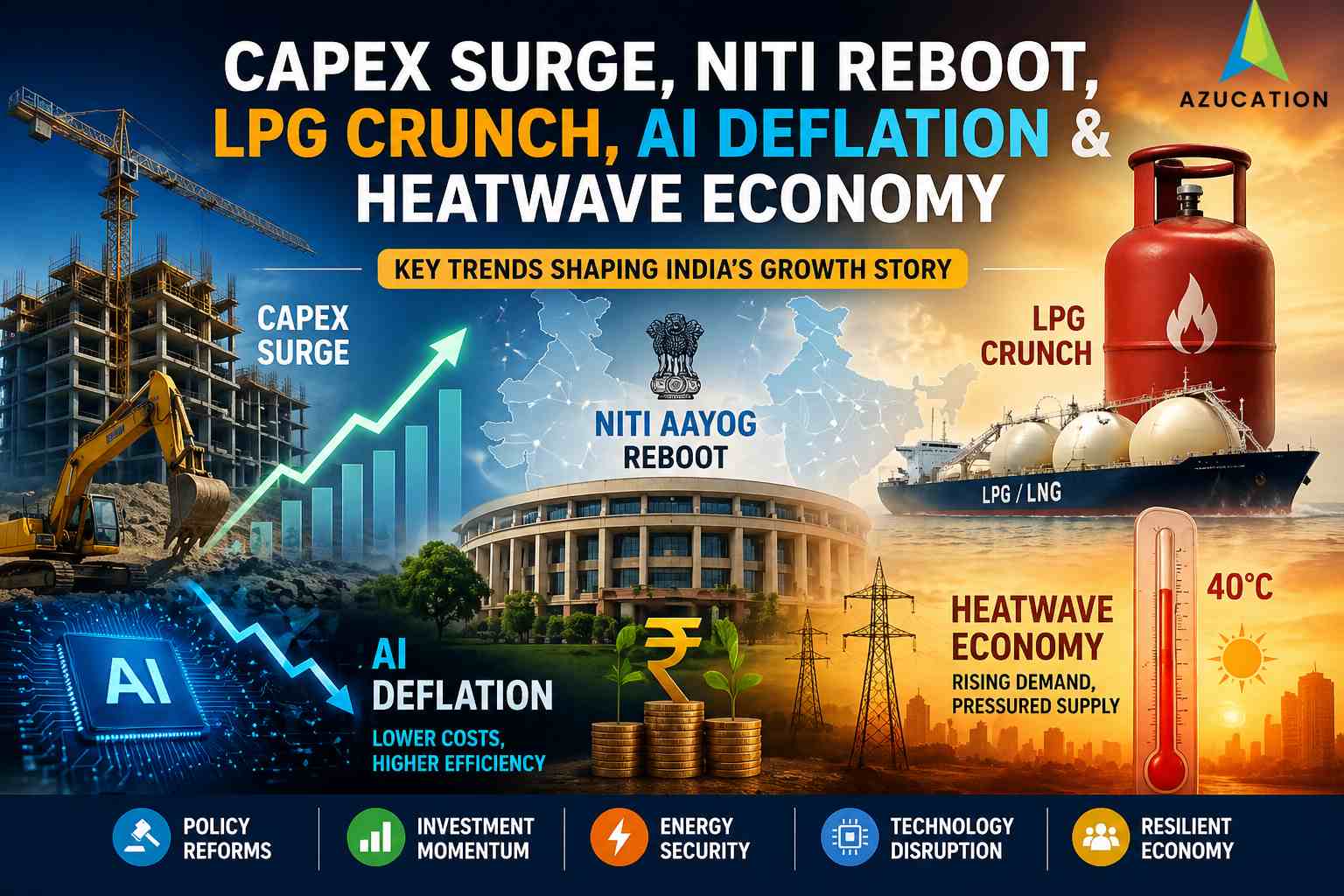
Capex Surge, NITI Reboot, LPG Crunch, AI Deflation & Heatwave Economy
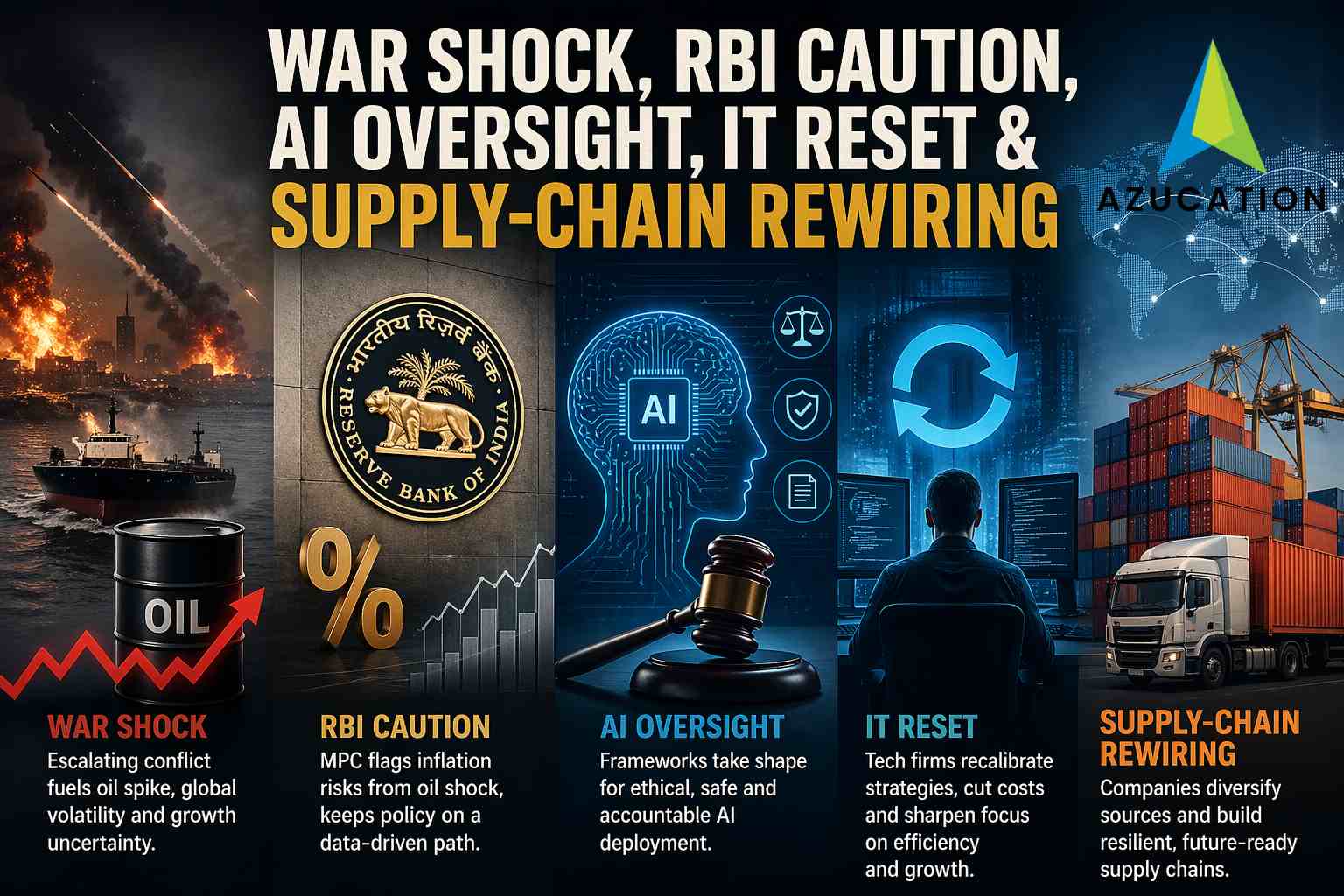
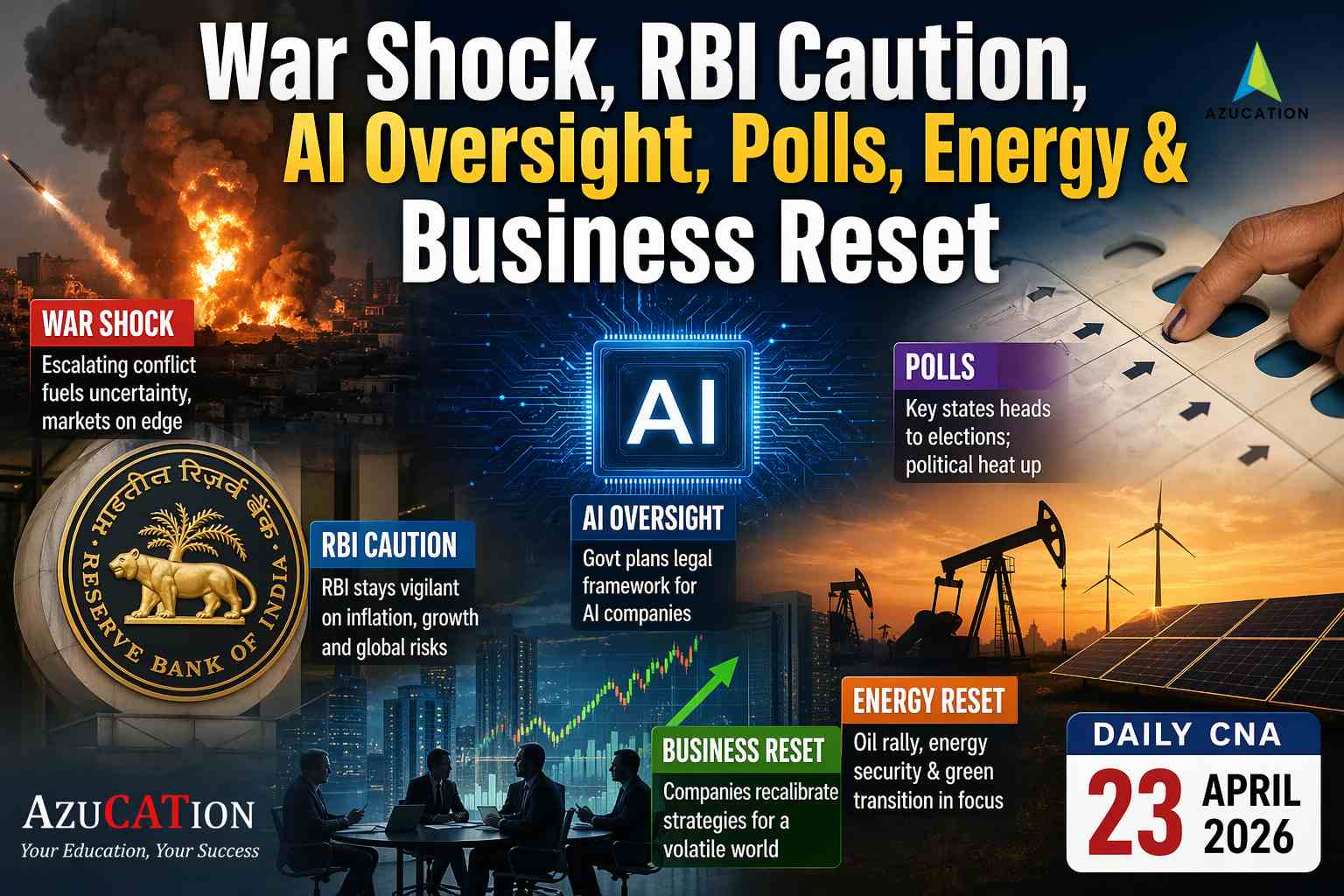
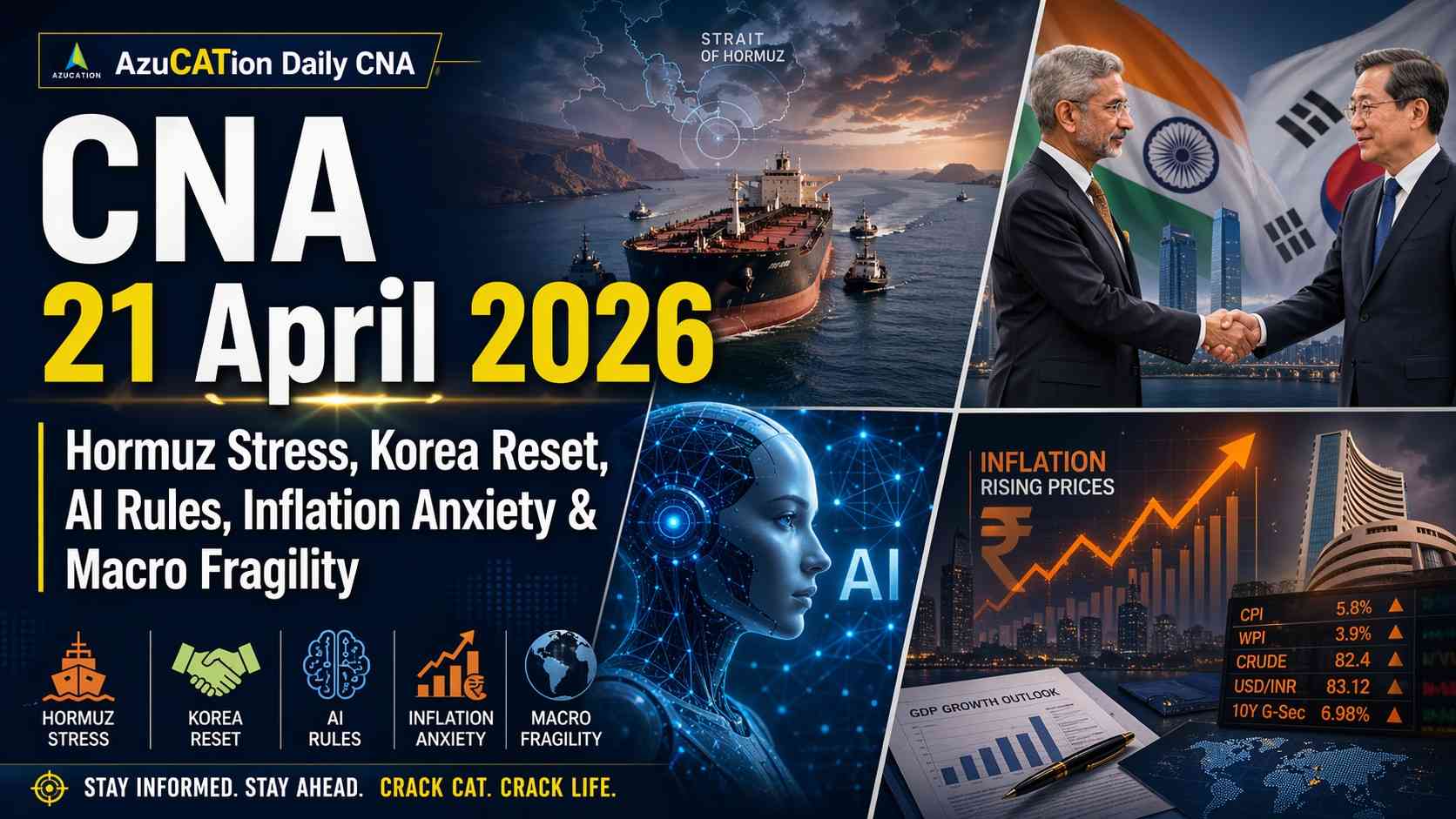
Today’s CNA is built around one central idea: India’s growth story is moving from “headline expansion” to “execution under stress”. Investment is rising, but energy, heat, AI disruption, trade imbalance and institutional reform are testing the quality of that growth.
The strongest way to read today’s news is through the lens of capacity under pressure. India is adding investment capacity, energy capacity, statistical capacity, AI governance capacity and insolvency capacity. But all of these are being tested by geopolitical shocks, climate-linked demand spikes, technological disruption and uneven domestic capability.
For GD-PI, do not memorise these as isolated facts. Connect them into one larger argument: India’s next growth phase will depend not only on capital formation, but also on supply-chain resilience, institutional coordination, energy security, urban data quality and workforce adaptability.
Quick Navigation
Private capex returns to the driver’s seat, but Q4 shows caution
The big signal is positive: investment intentions improved sharply in FY26. The warning is also clear: geopolitical uncertainty slowed new plans in the March quarter.
Fresh investment projects in India grew around 32% in FY26 to about ₹58.25 trillion, compared with ₹44.15 trillion in FY25. The private sector’s share of new projects topped 70%, supported by a sharp rise in domestic and foreign private investment commitments. Manufacturing was one of the strongest drivers, with new manufacturing plans rising sharply and sectors such as basic metals, chemicals, machinery and electronics leading the momentum.
However, the January-March quarter was weaker because the West Asia conflict, inflation worries and high energy prices made large project decisions riskier. This is important for MBA aspirants because it shows the difference between annual optimism and quarterly uncertainty. Businesses may want to invest, but they delay decisions when input costs, shipping routes, crude prices and demand visibility become uncertain.
Private capex is crucial because it signals confidence in future demand. But when private investment becomes selective, public capex may again have to stabilise growth momentum.
Corporate earnings also offered a mixed but encouraging signal. Early-bird companies reported double-digit profit growth in Q4FY26, the best pace in ten quarters, helped by banks, non-bank lenders and metals. At the same time, oil refiners were laggards because energy disruption compressed margins.
Interview line: India’s investment story is improving, but its durability will depend on whether firms can manage energy volatility, logistics risk and global demand uncertainty.
NITI Aayog reboot: policy think tank enters a more complex decade
Ashok Lahiri’s appointment as NITI Aayog vice-chairperson is not just a personnel change. It reflects a policy institution preparing for a more unstable global economy.
The Centre reconstituted the top leadership of NITI Aayog, appointing former Chief Economic Advisor Ashok Lahiri as vice-chairperson. NITI Aayog replaced the Planning Commission in 2015, and this leadership reset comes as India prepares its roadmap towards 100 years of independence while facing global shocks in energy, trade, technology and geopolitics.
This story is important because India’s development model now requires more coordination than before. Growth cannot depend only on central schemes. It needs coordination between ministries, states, private firms, universities, regulators and global partners. Issues such as AI governance, city-level labour data, energy security, critical minerals, education-to-employment and climate adaptation require cross-sector thinking.
A modern policy think tank must move beyond target-setting. It must identify bottlenecks, design reforms, measure outcomes and help states compete through better implementation.
For interviews, link this to cooperative federalism. States are increasingly important in investment attraction, skilling, urban planning, power distribution and industrial land. A strong NITI Aayog can help compare state performance, spread best practices and push evidence-based reform.
LPG, crude and fertiliser: West Asia risk reaches the kitchen, farm and factory
Energy security is not only about petrol prices. It affects cooking gas, fertiliser subsidy, food inflation, packaging, transport and corporate margins.
India is increasing LPG imports from the United States as supplies from key Gulf exporters remain disrupted. April data showed US LPG volumes rising while shipments from the UAE, Saudi Arabia, Qatar and Iran declined from earlier levels. This is a major energy-security signal because India depends heavily on imported LPG, and West Asia has historically supplied a large share due to proximity and lower freight costs.
Crude oil risks are also deepening. Continued disruption in the Strait of Hormuz has raised concern about volumes, not just prices. For India, which depends heavily on imported crude, the issue is not simply whether oil becomes expensive. The bigger issue is whether refiners can secure enough reliable supplies without overpaying for freight, insurance and alternative sourcing.
West Asia conflict → shipping disruption → LPG/crude/fertiliser input stress → higher subsidy or higher prices → pressure on fiscal math, companies and households.
Fertiliser is another critical link. Global urea and DAP prices have risen sharply, and the government has indicated that it may protect farmers from a price shock through a Covid-like subsidy approach. This protects farmers and food security, but it increases pressure on the fiscal deficit if global prices remain elevated.
Energy shocks are multi-sector shocks. They simultaneously affect consumer spending, industrial costs, agricultural input prices, logistics, government subsidy and inflation expectations.
Heatwave economy: power demand hits 256GW and India needs better city data
Climate stress is now an economic variable. It affects electricity demand, worker productivity, urban infrastructure and public health.
India’s peak power demand touched a fresh high of about 256GW as heatwaves pushed cooling demand across regions. The earlier record had been crossed only a day before, showing how quickly weather can test the grid. This is not simply an electricity story; it is a climate-economy story.
Higher power demand requires adequate coal, solar, hydro, transmission capacity and distribution-company preparedness. It also raises questions about urban heat, affordable cooling, demand forecasting, grid flexibility and energy transition. For India, the challenge is not only producing more electricity but also ensuring reliability during extreme demand spikes.
The heatwave economy makes infrastructure planning more complex. Power systems, labour laws, health systems and urban design must now account for extreme weather as a regular operating condition.
Another related development is the plan to release city-level statistical reports for 47 million-plus cities, covering labour force participation and unincorporated enterprises. This matters because Indian cities are engines of growth, but policy often suffers from weak city-level data. Better data can improve urban jobs policy, informal sector planning, city GDP estimates and targeted skilling programmes.
AI deflation in IT services and fintech’s shift to safer B2B models
AI is not just creating new revenue. It is also reducing effort, billing and human involvement in traditional technology services.
Top Indian IT services companies are acknowledging that AI can compress revenue in traditional service lines. More AI tools mean fewer human hours for coding, testing, maintenance and support, which can reduce billing rates. Companies expect AI-led work to eventually offset this pressure, but analysts remain cautious about how quickly that replacement revenue will arrive.
This is a powerful MBA topic because it shows the difference between productivity gain and revenue gain. A client may save money because AI completes work faster. But the vendor may earn less unless it creates new pricing models, outcome-based contracts, AI platforms or higher-value consulting.
The old IT model monetised effort. The new AI model must monetise outcomes, platforms, agents, data governance and transformation capability.
Fintech investing is also shifting. Investors are becoming cautious about heavily regulated consumer-facing fintech models and are showing more interest in B2B software, compliance infrastructure, payments infrastructure, risk tools and AI-led enterprise solutions. This shows that after regulatory shocks, capital often moves towards asset-light, recurring-revenue models with lower policy risk.
Interview line: AI will not simply destroy or create jobs; it will reorganise value capture. Firms that price outcomes will do better than firms that only sell effort.
Realty insolvency, India-Korea trade and infrastructure: reform must become operational
Several stories today point to one lesson: reform succeeds only when rules are translated into sector-level execution.
A committee has recommended major changes to real estate insolvency resolution, including project-wise resolution, higher threshold for bankruptcy filings, greater scrutiny of petitioners, RERA participation in creditor meetings and protection for completed units. This matters because real estate insolvency affects not only banks and developers but also ordinary homebuyers whose life savings can get stuck.
India-Korea trade also offers a policy lesson. Bilateral trade has expanded since the trade agreement, but India’s trade deficit has widened because imports from South Korea have grown faster than Indian exports. The lesson is that FTAs are not enough. India needs domestic capability, scale, quality, logistics efficiency and integration into global value chains to benefit fully from market access.
Trade agreements create opportunity, but competitiveness converts opportunity into exports. Without domestic capability, market access can become import dependence.
Infrastructure stories point in the same direction. Navi Mumbai airport is scaling up flight operations with IndiGo taking a dominant share, while real estate developers are using flexible payment plans to support demand without cutting headline prices. In both cases, execution details — connectivity, tariffs, fleet availability, cash-flow plans and buyer affordability — matter more than grand announcements.
GD-PI Interview Angles
Use these points to convert today’s news into mature interview answers.
1. Is India’s private capex revival sustainable?
Yes, if demand, policy stability and financing remain strong. But geopolitical energy shocks can delay mega projects, so public capex may still be needed as a stabiliser.
2. Why is NITI Aayog important now?
Because India needs evidence-based coordination across states, ministries, regulators and industry for AI, energy, skilling, urbanisation and investment.
3. How does West Asia affect India?
Through crude, LPG, fertiliser inputs, freight, insurance, inflation, fiscal subsidy and corporate margins. The impact is both macroeconomic and household-level.
4. Is AI a threat to Indian IT?
It is a threat to effort-based billing, but an opportunity for outcome-based pricing, automation platforms, AI governance and enterprise transformation.
5. Why is city-level data important?
Because urban jobs, informal enterprises, migration and services growth cannot be managed well with only national or state-level averages.
6. What is the lesson from India-Korea trade?
FTAs give access, but domestic capability decides outcomes. India must improve quality, scale, logistics and standards compliance.
WAT Themes from Today’s CNA
High-quality topics for MBA written ability practice.
- Private investment is necessary but not sufficient for inclusive growth.
- Energy security is the foundation of economic security.
- AI will reward adaptable workers and flexible business models.
- Climate change is no longer an environmental issue alone; it is an economic planning issue.
- India needs better city-level data for better jobs policy.
- Trade agreements work only when domestic industry is competitive.
- Real estate insolvency reform must protect both creditors and homebuyers.
- Public policy in the next decade must be evidence-led, not announcement-led.
RC Practice Quiz: The Execution Economy
Reading Passage
India’s current economic moment is defined by a paradox. On one hand, private investment intentions are rising, corporate profits are improving, and new policy institutions are being redesigned for a more complex global environment. On the other hand, energy disruption, heatwaves, AI-led revenue compression and trade imbalances show that growth can be slowed by execution gaps.
The lesson is that capacity creation must be matched by resilience. Investment must be protected from input shocks. Power systems must withstand climate stress. IT companies must move from effort-based billing to outcome-based pricing. Trade policy must be matched by domestic industrial capability. Urban policy must be driven by city-level data. In short, the next stage of India’s growth story will not be judged by announcements alone, but by how effectively institutions, firms and states execute under pressure.
1. What is the main theme of the passage?
2. Which of the following best explains “capacity creation must be matched by resilience”?
3. According to the passage, why are trade agreements not enough?
Your Result
Score will appear here.
Join AzuCATion for Daily CNA + GD-PI Preparation
Use this daily current news analysis to build interview-ready thinking, WAT points and business awareness for MBA preparation.
Editorial note: This CNA page is prepared for educational use by AzuCATion. It summarises and analyses reported business and policy developments for MBA aspirants.
Suggested slug: /cna-27-april-2026/