


 AzuCATion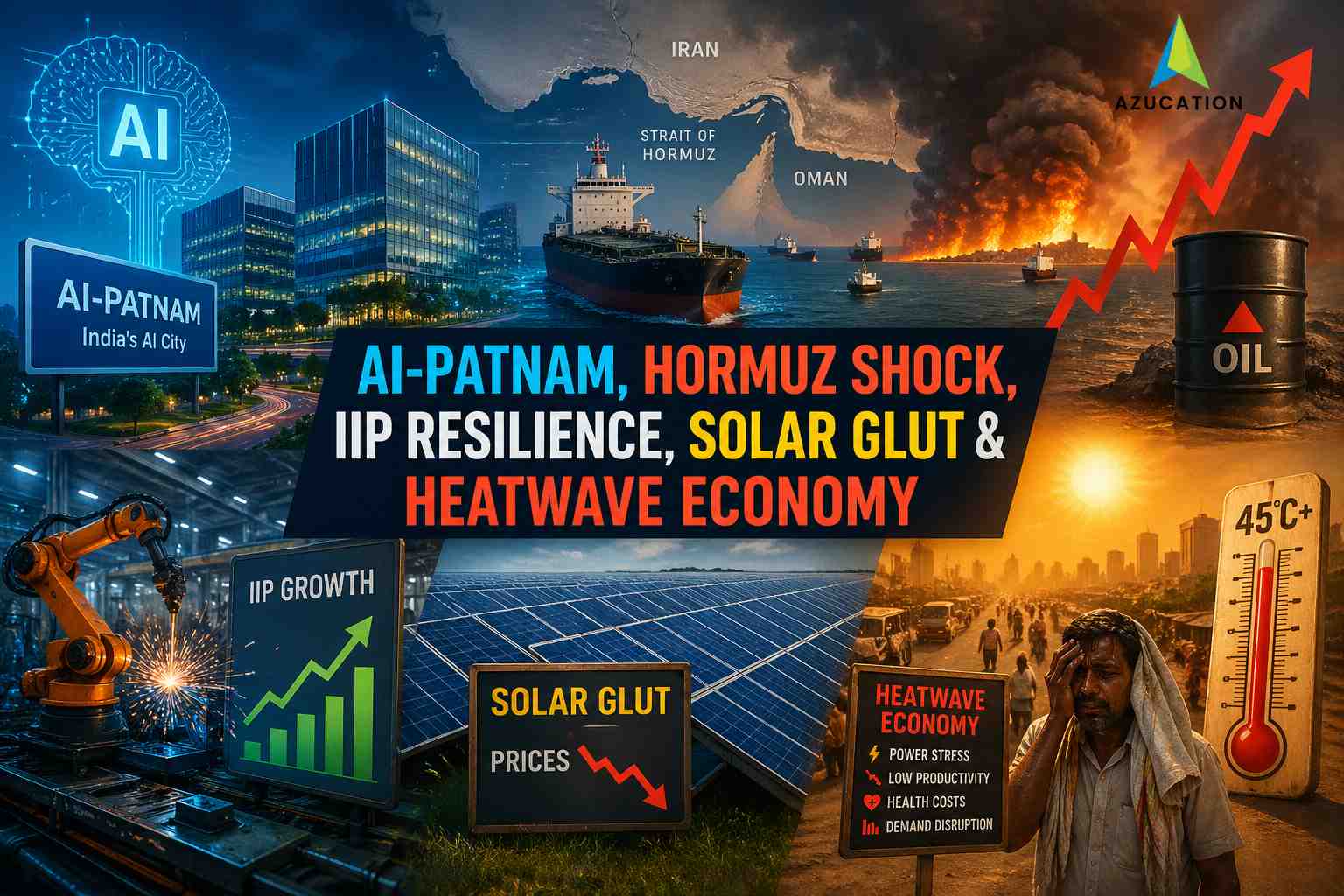
AI-patnam, Hormuz Shock, IIP Resilience, Solar Glut & Heatwave Economy
Today’s CNA is built around one powerful theme: India is growing inside a world of shocks. AI infrastructure is expanding, factories are still producing, but energy routes, climate stress, banking regulation and institutional delays are testing the strength of execution.
The most important reading of 29 April 2026 is not a single headline. It is the clash between capacity creation and system stress. India wants to build AI hubs, export corridors, manufacturing capacity, solar capacity and financial inclusion. But the same day also shows oil-route risk, heatwaves, regulatory tightening, court delays and weak job-platform participation.
For GD-PI, connect the dots: India’s next decade will not be judged only by how much it builds, but by whether institutions, workers, grids, banks and supply chains can absorb pressure without breaking.
Quick Navigation
Google’s $15 billion AI Hub: Visakhapatnam becomes “AI-patnam”
The biggest technology headline is not merely a data centre. It is a bet on India becoming a full-stack AI infrastructure location.
Google initiated work on the Google Cloud India AI Hub near Visakhapatnam, with a cumulative investment plan of about $15 billion over 2026-2030. The project is expected to include a gigawatt-scale AI and data infrastructure network and an AI industrial corridor around connectivity, compute capacity, local procurement and digital infrastructure.
The phrase “AI-patnam” is powerful because it suggests a shift from India as a software-services base to India as an AI infrastructure base. Data centres, cloud regions, submarine cable links, renewable energy, local hardware procurement and skilled manpower will together decide whether this investment creates an ecosystem or remains only a large facility.
AI infrastructure is the new industrial infrastructure. Just as ports and roads enabled trade, data centres and compute capacity will enable digital exports, AI products and enterprise transformation.
However, such projects also raise important questions: Will power supply be green and reliable? Will water usage be sustainable? Will local MSMEs enter the supply chain? Will the talent pipeline move beyond metros? These are the questions that turn a news headline into a GD-PI answer.
Interview line: India’s AI future will depend not only on models and apps, but also on physical infrastructure: power, data centres, cooling, chips, cables and skilled technicians.
IIP resilience and solar glut: India’s production engine sends mixed signals
Factories held up in March, but the power market showed a new-age paradox: record demand and near-zero solar-hour prices can exist together.
India’s IIP growth moderated to a five-month low of 4.1% in March from 5.1% in February. Manufacturing, the largest component of the index, grew 4.3%, mining grew 5.5%, while electricity growth was weak at 0.8%. Capital goods stood out with strong expansion, signalling investment activity, while consumer non-durables remained soft, hinting at uneven mass consumption.
This is important because March was the first month in which West Asia-linked disruptions and input-cost pressure could start appearing in industrial data. The number is not weak enough to suggest a breakdown, but it does warn that resilience may be tested in the coming months if crude, fertiliser, logistics and imported inputs remain volatile.
On the power side, exchange prices fell near zero during peak solar hours because excess daytime renewable generation met limited flexible demand. India has renewable capacity, but it needs storage, grid flexibility and round-the-clock clean power contracts.
For MBA students, this is a classic case of capacity without flexibility. Solar generation is valuable, but if it arrives when demand is low and storage is insufficient, price crashes. During evening peaks, when solar is unavailable, discoms may still need costly thermal power.
Hormuz shock and UAE exit from OPEC+: energy security becomes strategic
The oil story is moving beyond price. It is now about shipping routes, alliances, stockpiles and geopolitical bargaining.
The UAE announced that it would quit OPEC and OPEC+, creating a significant fracture inside the oil producers’ bloc. For India, the move could eventually help if UAE raises production and supplies more crude. But in the short term, the bigger issue remains the Strait of Hormuz disruption, because India depends heavily on imported crude, LNG and LPG from West Asia routes.
Oil prices rose as the US-Iran standoff over reopening the Strait of Hormuz continued. Reports indicated that before the war India sourced about 60% of its oil imports, 50% of LNG and nearly 90% of LPG from West Asia through this route. This makes the crisis directly relevant to India’s inflation, current account deficit, fertiliser subsidy, aviation fuel, logistics and household fuel security.
India urged restoration of safe maritime passage, said there was no proposal to hike petrol and diesel prices, and asked fertiliser firms to collectively source global supplies to negotiate better amid 50-60% price spikes in key inputs.
Interview line: Energy security is no longer only about buying cheap oil; it is about diversified sourcing, strategic reserves, maritime security and domestic alternatives.
Maruti, yield products and RBI ECL norms: markets reward predictability
Corporate India is showing demand strength, but investors and regulators are becoming more cautious about risk.
Maruti Suzuki reported record vehicle sales but a 6.4% decline in Q4 profit due to higher commodity prices and mark-to-market impact on debt investments. The company’s management emphasized that capacity utilisation, profitability and expansion matter more than market share alone. Maruti plans a historically high capex of about ₹14,000 crore in FY27 as it expands capacity in Haryana and Gujarat.
At the same time, IPO activity remained weak while yield-generating instruments such as InvITs, REITs and NCDs attracted investor interest. This shows that in uncertain macro conditions, investors often prefer predictable cash flows over growth stories with valuation risk.
RBI’s final expected credit loss framework will raise upfront provisioning, especially for unsecured retail, MSME and corporate exposures. Experts expect PSBs and mid-tier banks to feel a larger impact than large private banks.
For interviews, explain ECL simply: banks must recognise expected losses earlier instead of waiting for loans to fully turn bad. This improves transparency and stability, but it can reduce near-term profit and capital comfort.
Digital trust: Paytm licence, WhatsApp fraud action and AI copyright debate
The digital economy is entering a stricter phase where scale is no longer enough; compliance, trust and accountability matter.
RBI cancelled Paytm Payments Bank’s licence after years of regulatory concerns around operational structure, KYC controls, deposit limits and dependence on parent technology systems. For Paytm, the closure may remove one constraint on future lending options, but it also shows that fintech firms cannot grow on convenience alone; regulated finance requires strong compliance architecture.
WhatsApp informed the Supreme Court that it had removed about 9,400 accounts linked to digital arrest fraud and law-enforcement impersonation scams after a targeted investigation. The case shows how cybercrime has moved from random phishing to organised networks using fear, fake authority and platform scale.
The music industry debate around AI-generated tracks and fake plays adds another dimension: digital platforms must distinguish human creativity, licensed AI output, synthetic content and fraud.
India Inc. is also training blue-collar workers in AI tools for predictive maintenance, safety monitoring and error reduction. This matters because AI adoption is moving from office productivity to factory floors, plants and logistics.
Heatwave, jobs portal and inclusion: growth must protect people
The social side of today’s CNA is clear: a high-growth economy needs worker safety, labour-market data and real inclusion.
With temperatures reaching 40-46°C across many parts of India and Banda in Uttar Pradesh recording 47.6°C, the labour ministry asked states and Union Territories to protect workers, especially those in outdoor and physically demanding jobs. The advisory called for flexible work schedules, slower work pace during peak heat, ventilation, cooling facilities and awareness campaigns at labour hubs.
At the same time, registrations on the National Career Service portal fell sharply in FY26 across skill providers, placement organisations, employers and counsellors. This raises questions about the effectiveness of digital labour-market platforms when offline trust, employer participation and placement quality are weak.
Mint’s gender-budget analysis highlighted that India’s gender budget has grown to around ₹5 trillion, but women-led formal enterprise ownership and tracking of business survival remain weak. Spending is not the same as measurable empowerment.
For GD-PI, connect heatwaves with productivity, health expenditure, urban planning, insurance, labour law, ESG and climate adaptation. Climate is not just an environment topic; it is now a business, labour and macroeconomic topic.
GD-PI Interview Angles
Use these as ready frameworks for interview answers.
Is AI infrastructure India’s next export engine?
Say yes, but with conditions: power reliability, green energy, data governance, local supply chains, skill depth and cyber security will decide success.
Why is solar power falling to near-zero price?
Because generation is concentrated in daytime, while demand and storage are not flexible enough. The solution is storage, grid balancing and firm renewable contracts.
What does UAE’s OPEC+ exit mean for India?
It may create scope for higher UAE output, but India must focus on route security, strategic reserves and diversification rather than depend on one geopolitical outcome.
Are RBI’s ECL norms good or bad?
Good for transparency and early risk recognition; challenging for bank profits and capital in the short term, especially for PSBs and mid-tier lenders.
Why does Paytm’s licence cancellation matter?
It proves that fintech scale cannot substitute regulatory discipline. Trust, KYC, data governance and operational separation are core to financial innovation.
How should India respond to heatwaves?
Through heat action plans, labour protection, urban cooling, changed work hours, ESIC preparedness, water access and climate-resilient infrastructure.
WAT / Essay Themes from Today’s CNA
Pick any one and practise a 250-word answer.
- India’s AI future depends more on infrastructure than imagination.
- Energy security is the foundation of economic sovereignty.
- Renewable energy without storage can create a new kind of inefficiency.
- Fintech innovation must be balanced with consumer protection.
- Climate change is now a labour productivity issue.
- Can India turn welfare spending into measurable empowerment?
- Institutional delays weaken the promise of economic reform.
- Are predictable cash flows more valuable than high-growth stories in uncertain times?
RC Practice Quiz: 8-Minute Timer
Reading Passage
India’s current economic moment reflects a tension between capacity expansion and system stress. On one side, large AI infrastructure investments, higher manufacturing output and capacity expansion plans indicate confidence. On the other side, energy-route disruption, extreme heat, regulatory tightening and institutional delays show that growth cannot be understood through headline numbers alone.
The solar power market is a useful example. India has added renewable capacity, but daytime excess generation can pull exchange prices close to zero when demand is weak and storage is insufficient. Similarly, the digital economy has scaled rapidly, but Paytm’s licence cancellation and WhatsApp’s action against digital arrest fraud show that trust and compliance are now central to platform survival. The broader lesson is clear: India’s growth model needs resilience, not just expansion.
1. What is the central idea of the passage?
2. Why can solar power prices fall near zero even during a period of high electricity demand?
3. Which option best explains the Paytm and WhatsApp examples?
Prepare CNA like a future manager, not like a memoriser.
Use this page for daily reading, GD-PI thinking, WAT practice and RC speed improvement. Revise the numbers, but focus more on cause-effect and business impact.
Sources used: Business Standard Delhi, Economic Times Delhi and Mint Delhi editions dated 29 April 2026, along with the CNA April 27 page structure shared by the user.
Editorial note: This CNA is designed for MBA aspirants and focuses on analytical interpretation, GD-PI relevance and WAT practice rather than only headline summarisation.