


 AzuCATion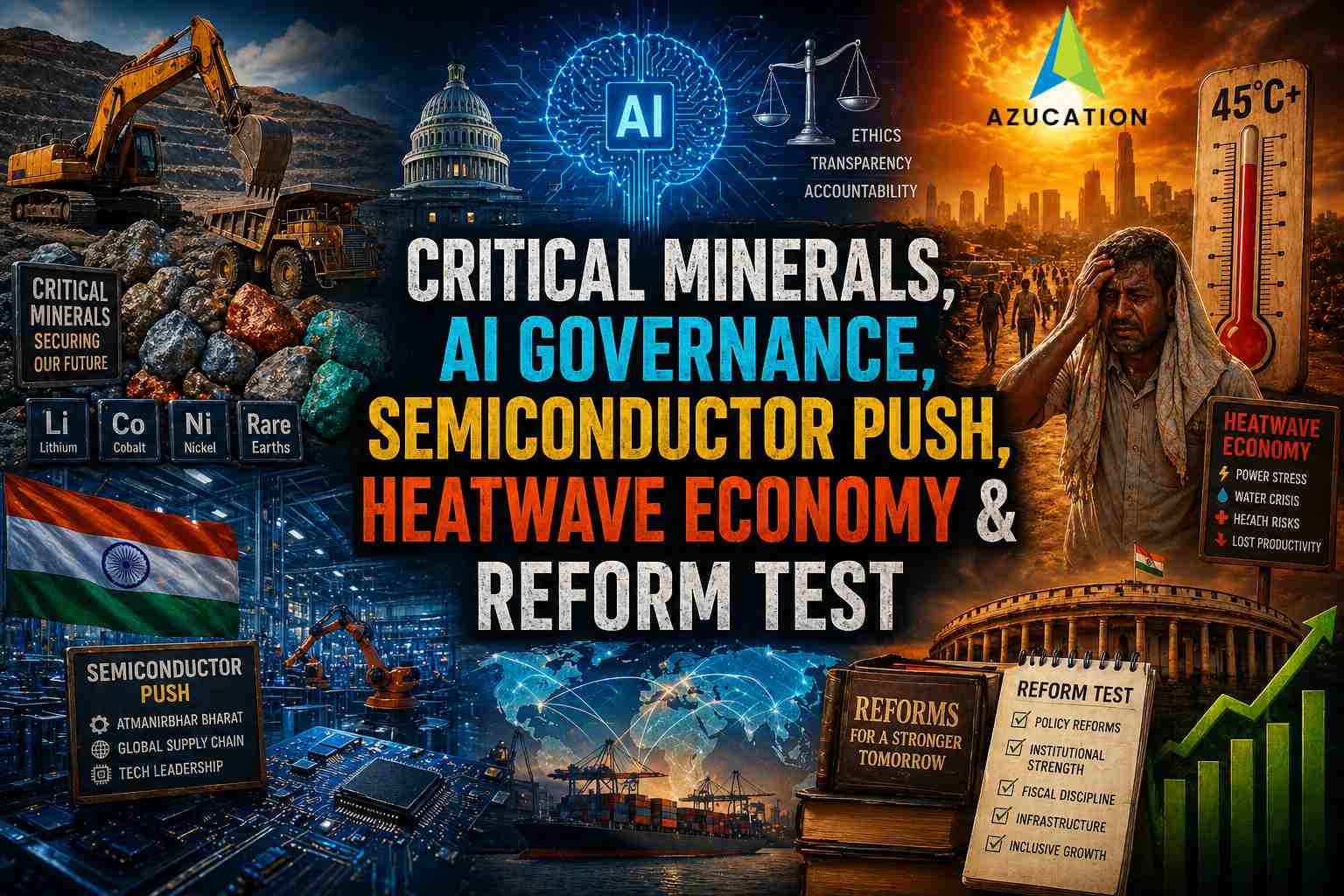
Critical Minerals, AI Governance, Semiconductor Push, Heatwave Economy & Reform Test
Today’s CNA is about India’s next growth bottleneck: not demand alone, but resilience. The country needs minerals for batteries, chips for manufacturing, rules for AI, cooler cities for workers, and institutions that can settle disputes before growth loses momentum.
The central theme for 20 April 2026 is resilience before acceleration. India can grow fast, but fast growth now depends on inputs that are globally contested: lithium, cobalt, nickel, rare earths, advanced chips, power, water, data and skilled workers.
For MBA interviews, the right answer is not simply “India should grow”. The sharper answer is: India must build buffers, reduce chokepoints and improve execution capacity so that global shocks do not repeatedly disturb domestic momentum.
Quick Navigation
Critical minerals: India’s green transition needs a strategic buffer
Lithium, cobalt, nickel, copper and rare earths are no longer only mining inputs; they are national competitiveness inputs.
India’s EV, battery storage, electronics and renewable-energy ambitions depend heavily on critical minerals. The strategic question is whether India can protect its manufacturing plans from sudden supply shocks, price spikes and geopolitical restrictions.
A six-month buffer idea is important because it treats minerals like energy security. Oil has strategic reserves because disruption can paralyse the economy. In the same way, battery minerals and rare earth elements can determine whether clean mobility, electronics manufacturing and grid storage remain on track.
The energy transition is not only about installing solar panels and EV chargers. It is about controlling the upstream supply chain that makes those technologies possible.
Semiconductor manufacturing: India’s move from assembly to capability
Chip manufacturing is not just another factory story; it is about strategic autonomy in a digital economy.
Semiconductors sit inside phones, cars, telecom networks, defence systems, medical devices, AI servers and consumer appliances. For India, the semiconductor push is linked to a larger ambition: moving from import-dependent electronics assembly to higher-value manufacturing.
The biggest challenge is that chip ecosystems require patient capital, clean utilities, skilled engineers, logistics discipline, intellectual property support and global partnerships. A plant alone does not create a semiconductor nation; it must be supported by design, testing, packaging, suppliers and talent.
A strong semiconductor base can reduce import dependence, support electronics exports and make India more attractive for global supply-chain diversification.
- GD angle: Should India subsidise strategic manufacturing sectors?
- PI angle: What is the difference between assembly-led growth and innovation-led manufacturing?
- WAT angle: “Strategic industries require state support, but not permanent protection.”
AI governance: innovation without trust becomes a risk multiplier
AI is entering cybersecurity, finance, education, recruitment and public services; governance must catch up.
AI is now powerful enough to assist coding, detect security flaws, automate decisions, generate content and influence consumer behaviour. The opportunity is clear: better productivity, faster service delivery and stronger cyber defence. But the risk is equally clear: misinformation, deepfakes, biased decisions, data leakage and autonomous cyber misuse.
India’s challenge is to build an AI governance model that is innovation-friendly but not careless. Over-regulation can slow adoption, while under-regulation can damage public trust. The middle path is risk-based regulation: stricter rules for high-impact uses such as banking, health, education, law enforcement and critical infrastructure.
Use the 4A framework: Accountability, Auditability, Accuracy and Appeal. Any AI decision affecting a person should be explainable, reviewable and contestable.
Heatwave economy: climate risk enters inflation, labour and productivity
Heatwaves are not only weather events. They are economic events.
Extreme heat affects farms, construction, logistics, street vending, factories and schools. It raises irrigation demand, electricity consumption and health risks. If heat persists, food supply can weaken, power demand can spike and worker productivity can fall.
For a developing economy, the heatwave economy is a distributional issue too. White-collar workers may shift to air-conditioned spaces, but outdoor workers carry the immediate burden. That is why heat action plans, drinking water access, shaded work breaks, early-warning systems and city-level cooling infrastructure are becoming part of economic policy.
Climate adaptation is no longer charity or CSR. It is productivity policy, inflation policy and urban governance policy.
Clean mobility and fuel transition: ethanol, EVs and the infrastructure gap
India wants cleaner transport, but consumer adoption depends on fuel availability, cost and trust.
The clean-mobility transition is moving on multiple tracks: EVs, ethanol blending, flex-fuel vehicles, hydrogen pilots and public transport. Each option has a different use case. EVs work best where charging is reliable. Ethanol helps reduce crude dependence but needs compatible engines and feedstock discipline. Hydrogen may be relevant for heavy transport, but remains infrastructure-intensive.
The key policy lesson is that technology transition cannot be pushed only from the supply side. Consumers need charging points, resale confidence, safety assurance, financing support and clear total-cost-of-ownership benefits.
India should avoid one-fuel thinking. A diversified clean-mobility strategy can reduce oil dependence while giving industry time to adapt.
Institutions and insolvency: growth also needs faster dispute resolution
Infrastructure, credit and investment depend on the credibility of institutions.
India’s insolvency framework was designed to resolve stressed assets in a time-bound manner. When tribunals are understaffed or cases are delayed, creditors lose confidence, asset value erodes and investment becomes more cautious.
This is why NCLT capacity, judicial infrastructure, digital case management and predictable timelines matter for economic growth. A country can announce large investments, but if contracts and insolvency cases remain slow, capital becomes expensive.
Ease of doing business is not only about permissions. It is also about enforcement, recovery, dispute resolution and institutional capacity.
“The next phase of reforms must focus not only on creating new opportunities, but also on reducing the friction that slows existing opportunities.”
GD-PI Discussion Angles
Use these points to convert news into interview-ready arguments.
1. Are critical minerals the new oil?
Yes, because future energy security will depend on battery inputs, rare earths and processing capacity, not only crude oil.
2. Should India subsidise chip manufacturing?
Yes, but with milestones. Strategic sectors need support, but subsidies must be linked to ecosystem creation and exports.
3. Is AI regulation urgent?
Yes, especially for high-risk sectors. India needs innovation with accountability, not a blanket ban or blind adoption.
4. Why are heatwaves an economic issue?
They influence food prices, labour productivity, power demand, health costs and urban planning.
WAT Themes for Practice
Pick any one and write a 250-word answer in 20 minutes.
- Critical minerals will decide the future of green growth.
- AI governance must protect trust without killing innovation.
- Climate adaptation is now an economic necessity.
- India’s manufacturing dream needs chips, skills and institutions.
- Clean mobility requires infrastructure before slogans.
- Fast growth needs faster dispute resolution.
RC Practice Quiz: Resilience Economy
Passage
India’s current development challenge is no longer limited to expanding demand. The more complex challenge is building resilience into the foundations of growth. Critical minerals, semiconductors, AI governance, climate adaptation and institutional capacity are now central to economic strategy. A supply shock in minerals can slow EV manufacturing; a heatwave can raise food and power costs; weak AI governance can reduce digital trust; and slow dispute resolution can raise the cost of capital.
This means policy must move beyond announcement-led optimism. The next phase of competitiveness will depend on buffers, standards, infrastructure, talent and predictable institutions. Growth will remain attractive only if the system can absorb shocks without repeatedly transferring the cost to consumers, workers and investors.
Prepare CNA like an MBA candidate, not like a headline reader.
Read the news, connect the sectors, build arguments and practise GD-PI answers daily with AzuCATion.
Editorial note: This CNA page is prepared for MBA/CAT current-affairs learning. It converts daily news themes into analysis, interview angles, WAT themes and RC practice.
Suggested use: Revise the story cards first, then practise one WAT theme and finally attempt the RC quiz without scrolling back.